What is Estimation Test Plans ?
An Estimation Test Plan determines the sample size and test duration needed to estimate reliability parameters such as mean time to failure (MTTF), failure rate, or percentile life with a defined level of precision. Unlike demonstration plans, estimation plans produce quantitative reliability estimates rather than simply confirming a pass/fail threshold.
Simple Definitions: A test plan designed to estimate how reliable a product actually is specifying exactly how much testing is needed to produce a precise, statistically valid estimate of failure rates or survival times.
When to use Estimation Test Plans?
- Use to estimate failure rate, MTTF, or reliability percentiles rather than simply demonstrate a minimum level.
- Use during product development and characterisation when you want to quantify reliability behaviour.
- Use when some failures are expected during testing and will be used to fit a statistical model.
Guidelines for correct usage of Estimation Test Plans
- Specify the desired precision of the estimate the confidence interval width before designing the test.
- Select the appropriate failure time distribution based on engineering knowledge Weibull is most commonly used.
- Plan for time-censored or failure-censored testing depending on whether you stop at a fixed time or after a fixed number of failures.
Alternatives: When not to use Estimation Test Plans
- If confirming compliance with a minimum threshold, use Demonstration Test Plans
- If failure data already exists, use Parametric Distribution Analysis to analyse it directly without additional testing.
Example of Estimation Test Plans
The following steps for Estimation Test Plans:
- Fill the required options.
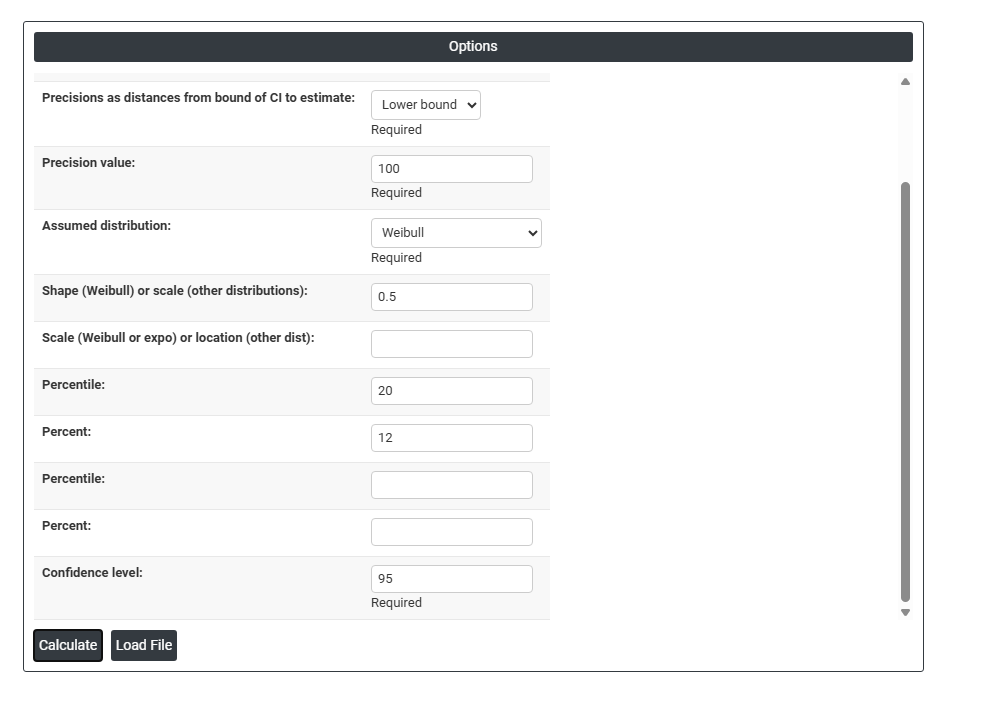
2. Now analyses the data with the help of https://qtools.zometric.com/ or https://intelliqs.zometric.com/.
3. To find Estimation Test Plans choose https://intelliqs.zometric.com/> Statistical module> Reliability>Estimation Test Plans.
4. After using the above mentioned tool, fetches the output as follows:

How to do Estimation Test Plans
The guide is as follows:
- Login in to QTools account with the help of https://qtools.zometric.com/ or https://intelliqs.zometric.com/
- On the home page, choose Statistical Tool> Reliability>Estimation Test Plans.
- Next, you need to fill the required options.
- Finally, click on calculate at the bottom of the page and you will get desired results.
On the dashboard of Estimation Test Plans, the window is separated into two parts.
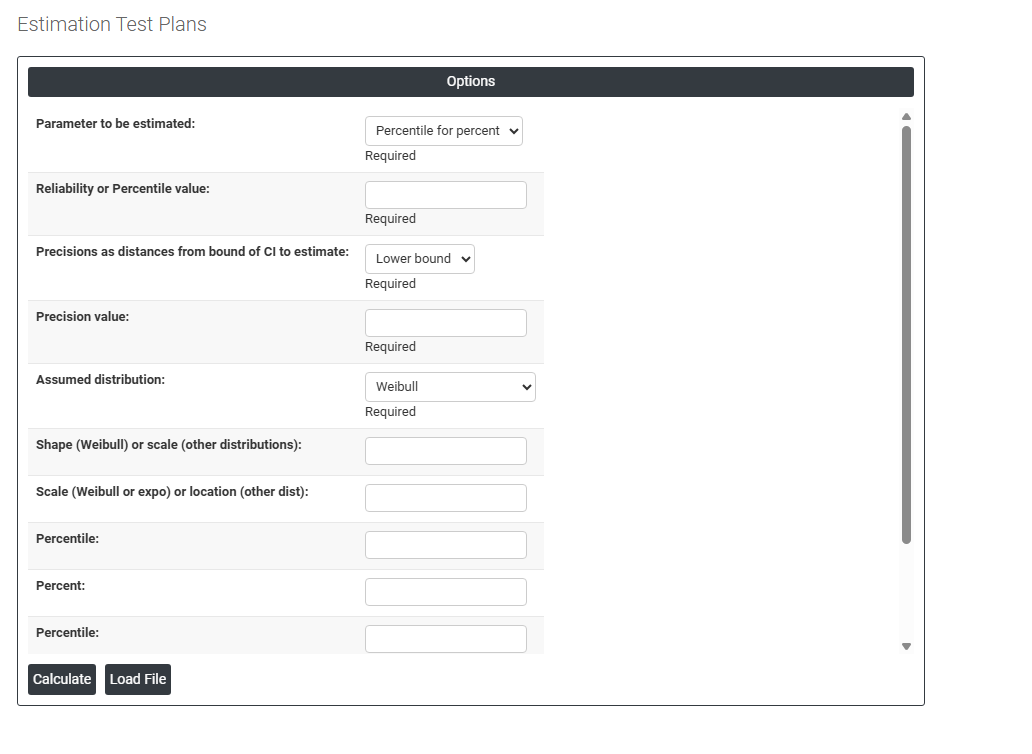
Load example: Sample data will be loaded.
Load File: It is used to directly load the excel data.
On the right part, there are many options present as follows:
- Parameter to Be Estimated: Defines what reliability characteristic the test is designed to estimate precisely. Choose Percentile to estimate a specific failure time (e.g. the time by which 10% of units will fail), or Reliability to estimate the probability of surviving to a specified time.
- Reliability or Percentile Value: Enter the specific value you want to estimate for example, 10% for B10 life estimation, or 0.95 for estimating 95% reliability at a specific time.
- Precision as Distance from Bound of CI to Estimate: Defines how precisely the parameter needs to be estimated. Lower bound means you want the confidence interval to extend a specified distance below your estimate useful when the lower end of the reliability estimate is most critical for decision-making.
- Precision Value: The maximum acceptable distance between your point estimate and the confidence bound effectively the half-width of the confidence interval. Smaller values require larger sample sizes or longer test durations.
- Assumed Distribution: Select the failure time distribution Weibull, Exponential, Normal, Lognormal, and others that best describes how your product fails. This must be specified before the required sample size and duration can be calculated.
- Shape (Weibull) or Scale (Other Distributions): The assumed shape or scale parameter value, based on prior knowledge or engineering judgement. For Weibull, the shape parameter determines whether failures are early-life, random, or wear-out in nature.
- Scale (Weibull/Expo) or Location (Other Distributions): The assumed scale parameter for Weibull or Exponential, or the assumed location (mean) parameter for other distributions. Together with the shape, this defines the complete assumed failure time distribution.
- Percentile / Percent: If estimating a percentile, enter the specific percent value for example, 10 for B10 life or 50 for median life. These values define which point on the failure time distribution is being targeted for estimation.
- Confidence Level: Sets the confidence level for the resulting confidence interval around the estimated reliability parameter. The standard default is 95%.