R- Chart
An R Chart (Range Chart) monitors the spread or variation within subgroups over time by plotting the range — the difference between the highest and lowest value — of each subgroup. It is always used alongside an Xbar chart and is the primary tool for checking whether process variation is staying stable and consistent.
Last reviewed
Key takeaway
An R Chart (Range Chart) monitors the spread or variation within subgroups over time by plotting the range — the difference between the highest and lowest value — of…
On this page
What is R Chart?
An R Chart (Range Chart) monitors the spread or variation within subgroups over time by plotting the range — the difference between the highest and lowest value — of each subgroup. It is always used alongside an Xbar chart and is the primary tool for checking whether process variation is staying stable and consistent.
While the Xbar chart tells you where the process average is sitting, the R chart tells you how much the measurements are spreading within each sample. Together they give a complete picture of process behaviour.
When to use R Chart?
- Use when subgroup size is between 2 and 8 — the range is a reliable and simple measure of variation for small subgroups.
- Always use alongside an Xbar chart — the R chart monitors variation while the Xbar chart monitors the process mean.
- Use when data is continuous and subgroups are collected at regular, defined time intervals.
- Use when you want a quick, easy-to-calculate measure of within-subgroup variation without complex computation.
Guidelines for correct usage of R Chart
- Always interpret the R chart before the Xbar chart — if variation is unstable, the Xbar control limits cannot be trusted.
- Keep subgroup size fixed and consistent — changing subgroup sizes invalidates the control limits.
- Collect at least 25 subgroups before establishing control limits and drawing conclusions.
- An R chart value of zero is acceptable and simply means all values in the subgroup are identical — it is not an error.
- Data within subgroups should be independent and approximately normal for control limits to be statistically valid.
Alternatives: When not to use R Chart
- If subgroup size is greater than 8, use S Chart (Standard Deviation Chart) instead — it is more statistically accurate for larger subgroups.
- If data is collected as individual measurements with no subgroups, use I-MR Chart
- If you need to monitor both within-subgroup and between-subgroup variation, use I-MR-R/S (Between/Within) Chart
- If the response is attribute data (defect counts or proportions), use P, NP, C, or U charts
- If you are running short production runs or mixed part types, use Z-MR Chart
Example of R Chart
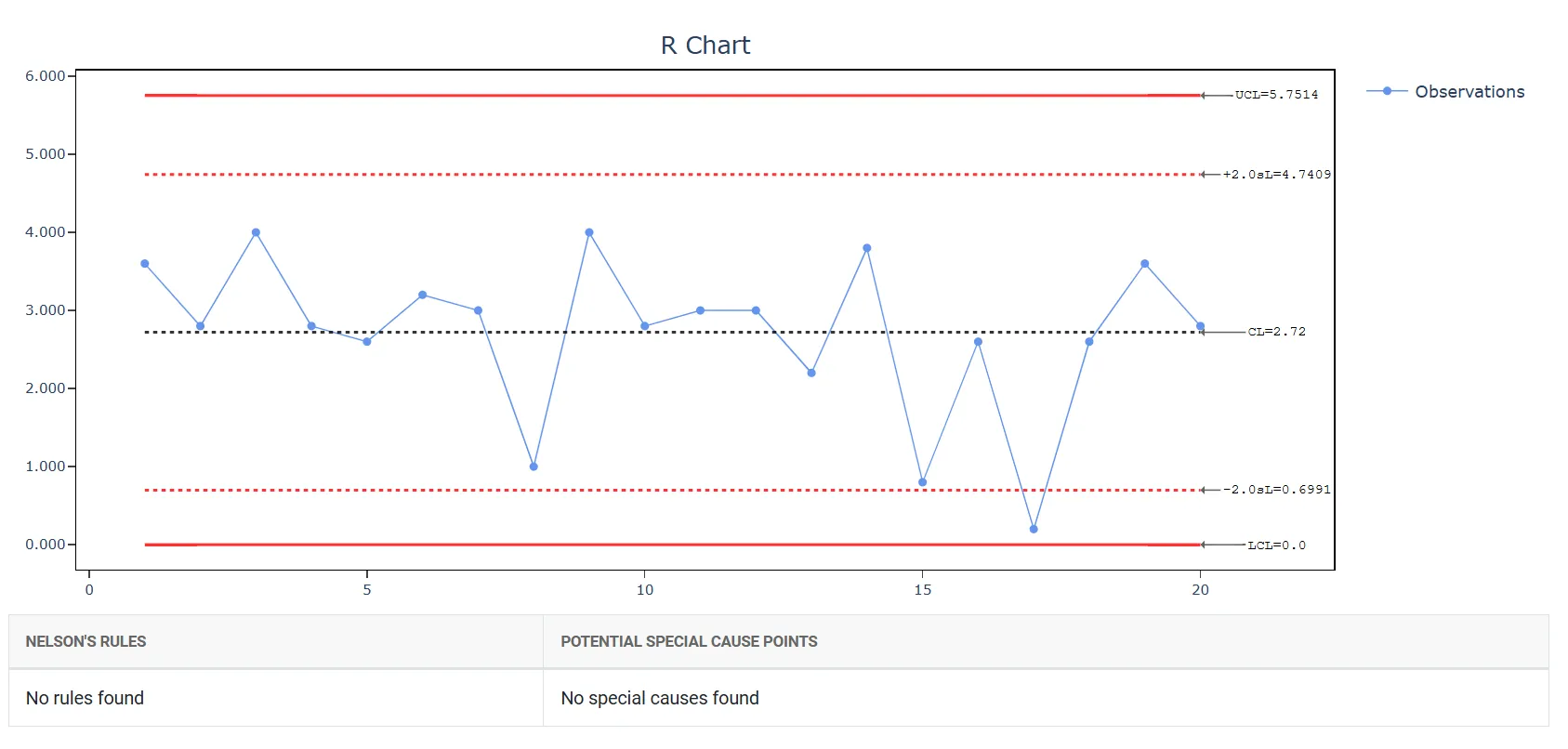
A quality engineer at an automotive parts plant monitors the lengths of camshafts. The engineer collects data in subgroup sizes of 5 every 30 minutes. He is interested in looking for special causes, if any in control chart. 1. Leave the process mean and process stddev empty as they are unknown as of now. 2. Enable all 8 Nelson's rules
To address this, the engineer applies the R Chart and performs the following steps:
- Gathered the necessary data.
- Now analyses the data with the help of https://qtools.zometric.com/ or https://intelliqs.zometric.com/.
- To find R Chart choose https://intelliqs.zometric.com/> Statistical module> Control Charts>R Chart.
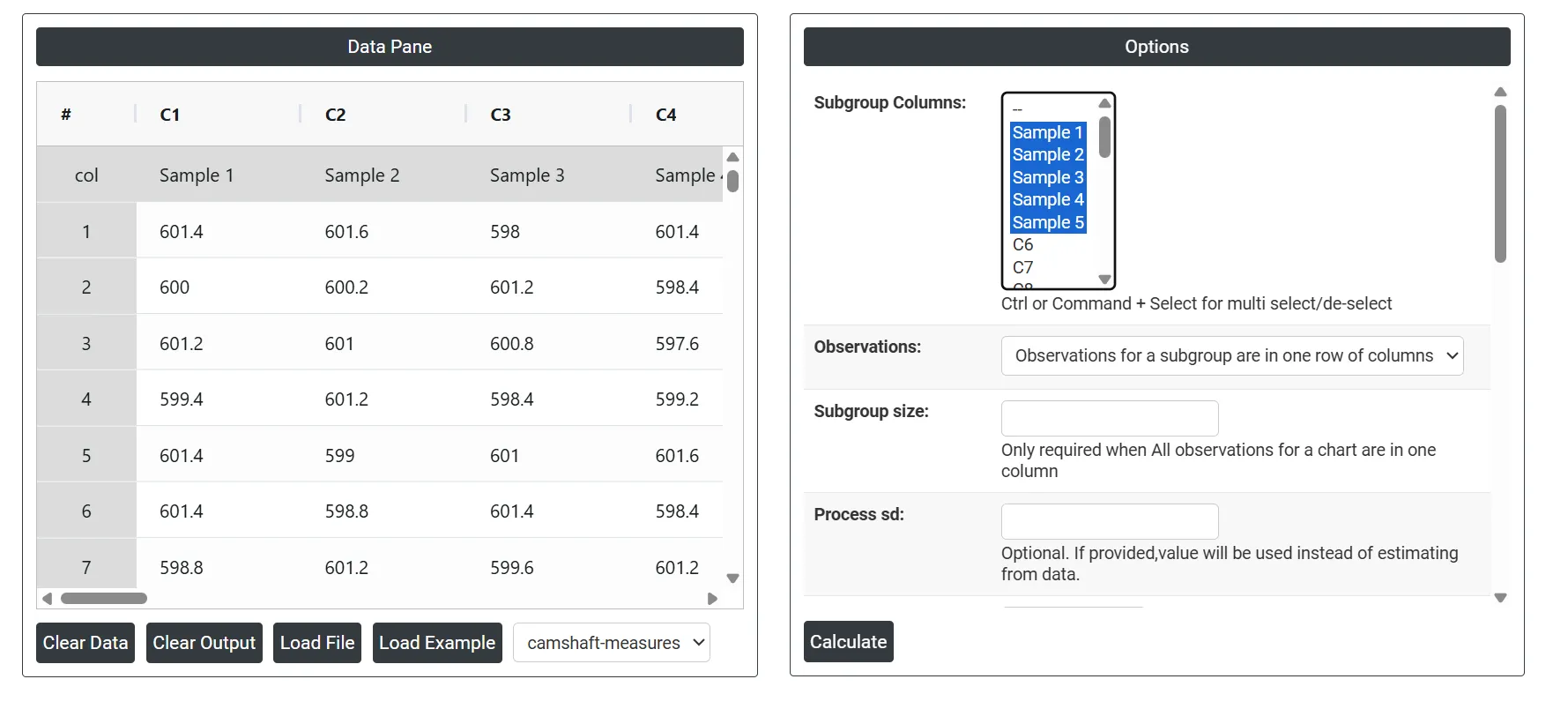
- Inside the tool, feeds the data along with other inputs as follows:
5. After using the above mentioned tool, fetches the output as follows:
How to do R Chart
The guide is as follows:
- Login in to QTools account with the help of https://qtools.zometric.com/ or https://intelliqs.zometric.com/
- On the home page, choose Statistical Tool> Control Charts >R Chart.
- Click on R Chart and reach the dashboard.
- Next, update the data manually or can completely copy (Ctrl+C) the data from excel sheet and paste (Ctrl+V) it here.
- Next, you need to fill the required options .
- Finally, click on calculate at the bottom of the page and you will get desired results.
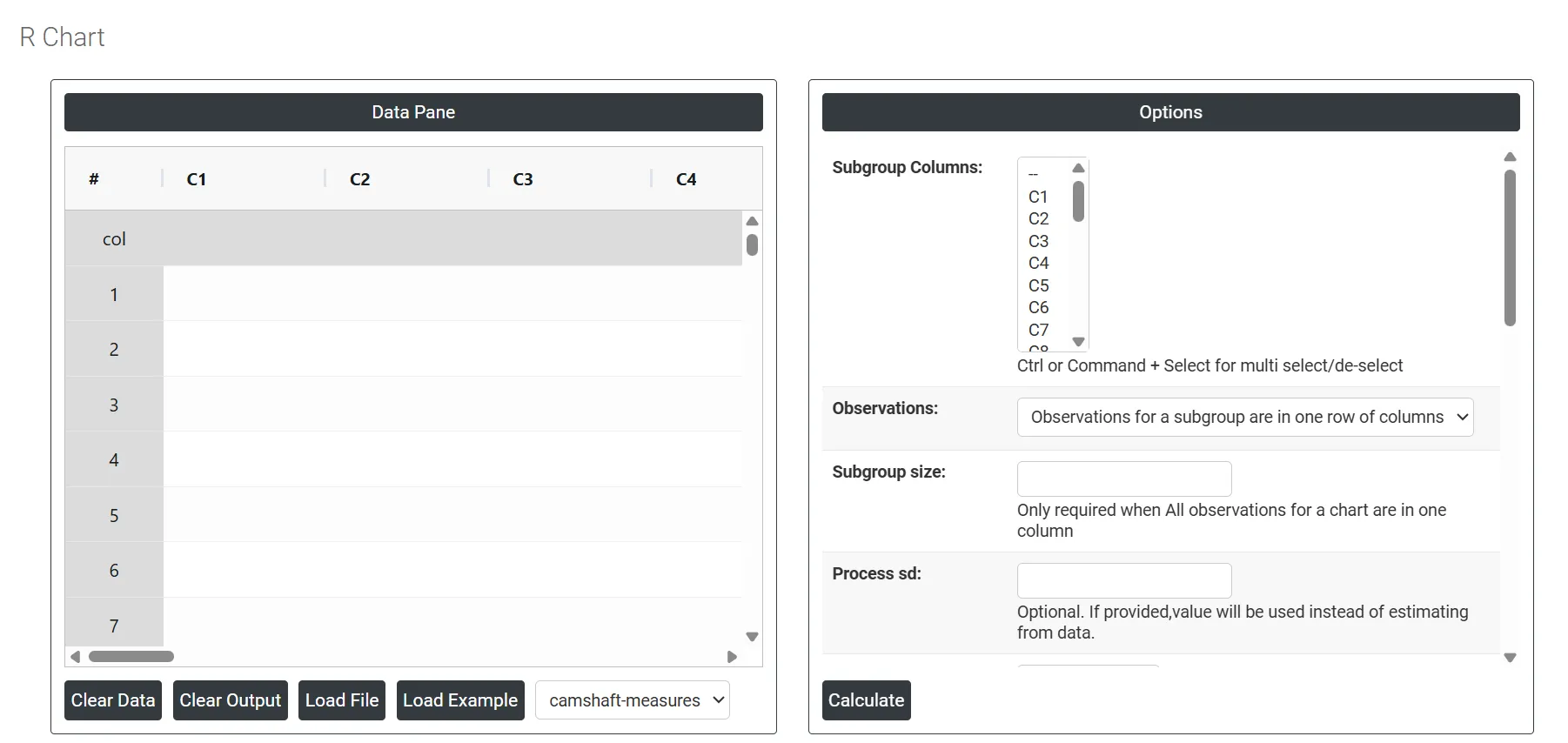
On the dashboard of R Chart, the window is separated into two parts.
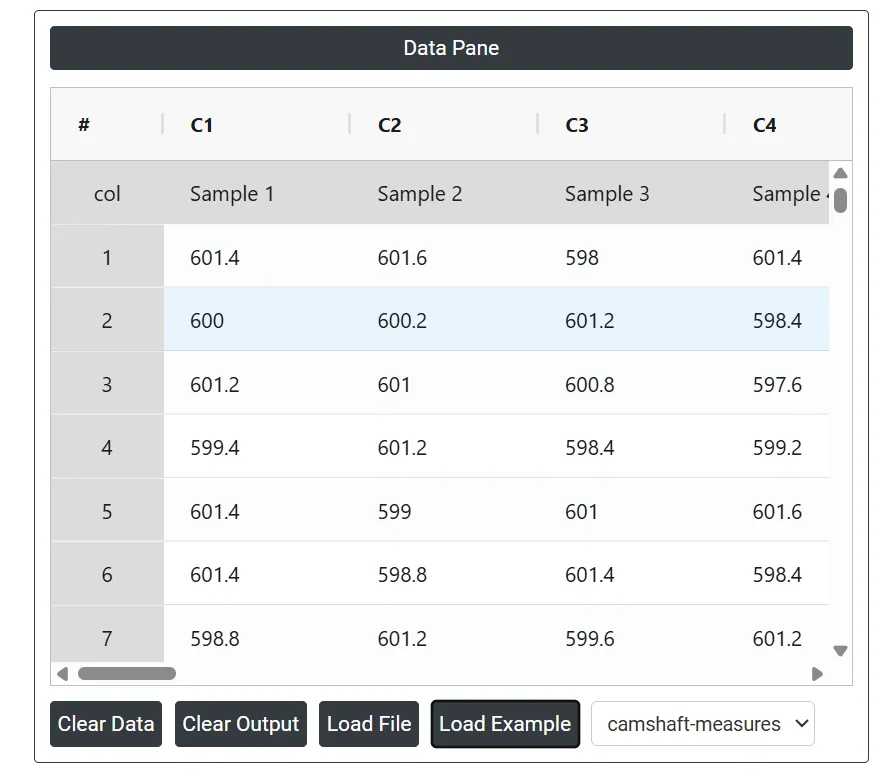
On the left part, Data Pane is present. In the Data Pane, each row makes one subgroup. Data can be fed manually or the one can completely copy (Ctrl+C) the data from excel sheet and paste (Ctrl+V) it here.
Load example: Sample data will be loaded.
Load File: It is used to directly load the excel data.
On the right part, there are many options present as follows:
- Subgroup Columns Allows you to select either a single column or multiple columns depending on how your data is structured. If each subgroup is spread across multiple columns (one column per measurement position), select all those columns. If all measurements are stacked in one column, select that single column and define the subgroup size separately. The selection here directly determines how the chart groups your data for calculating subgroup averages.
- Observations: This setting defines how your data is physically laid out in the worksheet. Choose the option that matches your data structure:
- Observations for a subgroup are in one row of columns — each row contains all measurements for a single subgroup, spread across multiple columns. For example, Row 1 has five measurements representing Subgroup 1 across five columns.
- All observations for a chart are in one column — all measurements are stacked vertically in a single column, and the subgroup size field is used to define how many rows belong to each subgroup.
Selecting the wrong layout here will cause the chart to group data incorrectly and produce invalid control limits.
- Subgroup Size Only required when all observations are stored in a single column. This tells the chart how many consecutive rows make up one subgroup. For example, if subgroup size is 5, the chart will treat rows 1–5 as subgroup 1, rows 6–10 as subgroup 2, and so on. If your data is already arranged in multiple columns (one per measurement), this field is not needed as the subgroup size is defined by the number of columns selected.
- Process sd: It is a measure of the variability or dispersion of the process data around the mean. It provides an indication of how much individual data points within the process differ from the process average. If not, Zometric Q-Tools calculates from the data provided.
- Sd estimation method: This leaves the user with two choices for the calculation. Choosing Rbar as the estimation method or pooled standard deviation method changes the result.
- Rbar Sd estimation method: Estimates process standard deviation by averaging the standard deviations across all subgroups and applying a statistical correction factor. This method is recommended for subgroup sizes greater than 8, as it uses every data point in each subgroup to produce more accurate and reliable control limits than the range-based method.
- Pooled Sd estimation method: The pooled standard deviation is the weighted average of subgroup variances, with larger subgroups having a greater impact on the overall estimate. This method offers a more accurate estimate of the standard deviation when the process is stable.
- Use unbiasing constants for pooled sd: This option is applicable only when Stdev is estimated using Pooled Stdev method.
- Show Decimals Controls how many decimal places are displayed on the chart for the plotted values, control limits, and centre line. Increasing decimals gives more precision in reading the chart; reducing them keeps the chart clean and easier to present. Choose the level that balances accuracy with readability for your audience.
- Check Rule 1: 1 point > K Stdev from center line: Test 1 is essential for identifying subgroups that significantly deviate from others, making it a universally recognized tool for detecting out-of-control situations. To increase sensitivity and detect smaller shifts in the process, Test 2 can be used in conjunction with Test 1, enhancing the effectiveness of control charts.
- Check Rule 2: K points in a row on same side of center line: Test 2 detects changes in process centering or variation. When monitoring for small shifts in the process, Test 2 can be used in conjunction with Test 1 to enhance the sensitivity of control charts.
- Check Rule 3: K points in a row, all increasing or all decreasing: Test 3 is designed to identify trends within a process. This test specifically looks for an extended sequence of consecutive data points that consistently increase or decrease in value, signaling a potential underlying trend in the process behavior.
- Check Rule 4: K points in a row, alternating up and down: Test 4 is designed to identify systematic variations within a process. Ideally, the pattern of variation in a process should be random. However, if a point fails Test 4, it may indicate that the variation is not random but instead follows a predictable pattern.
- Check Rule 5: K out of K + 1 points > 2 standard deviation from center line (same side): Test 5 detects small shifts in the process.
- Check Rule 6: K out of K + 1 points > 1 standard deviation from center line (same side):Test 6 detects small shifts in the process.
- Check Rule 7: K points in a row within 1 standard deviation of center line (either side):Test 7 identifies patterns of variation that may be incorrectly interpreted as evidence of good control. This test detects overly wide control limits, which are often a result of stratified data. Stratified data occur when there is a systematic source of variation within each subgroup, causing the control limits to appear broader than they should be.
- Check Rule 8: K points in a row > 1 standard deviation from center line (either side):Test 8 detects a mixture pattern. In a mixture pattern, the points tend to fall away from the center line and instead fall near the control limits.
- Additional CLs at Multiples of SD 1 Adds an extra control limit line at ±1 standard deviation from the centre line. This creates an inner boundary zone on the chart, useful for applying Western Electric or Nelson rules that look for unusual patterns within the control limits — such as a run of points consistently on one side of the centre line.
- Additional CLs at Multiples of SD 2 Adds an extra control limit line at ±2 standard deviations from the centre line. This creates a middle warning zone between the centre and the standard ±3 sigma control limits. Points falling between the 2-sigma and 3-sigma lines can signal an early warning of a process shift before a point actually goes out of control.
- Define Stages (Historical Groups) with This Variable Allows you to split the chart into distinct phases or stages using a grouping variable. Each stage gets its own set of control limits calculated independently. This is useful when a known process change occurred — such as a new machine, a process improvement, or a shift in raw material — and you want to compare process performance before and after that change on the same chart.
- X Scale Controls how the horizontal axis of the chart is displayed. You can adjust the scale to show time-based labels, subgroup numbers, or custom values. This is useful when your subgroups correspond to specific dates, shifts, or batches and you want the chart axis to reflect that context rather than just sequential numbers, making the chart easier to read and present.