
Control Plan
On this page
Purpose
Control Plan turns a worksheet with one row per product or process characteristic into a control plan in the familiar AIAG / IATF 16949 layout, reviews every row for the gaps auditors usually find, and links each characteristic to the StatsAI study that supports it: the measurement system study to run first, the control chart to monitor it with, and the capability study and target. Use it at the end of an improvement project (the Control phase), for a new part at prototype or pre-launch, or to review an existing plan.
Key Capabilities
- Reads the worksheet columns by their names, so an existing control plan pasted from Excel usually works as it is (see the column list below).
- Header block with project name, control plan number, phase (Prototype, Pre-launch, Safe launch or Production), part number and change level, part name, plant, key contact, core team, dates and approval.
- Characteristics table in the standard column order, with special characteristics (CC, SC, KPC, ◆ and similar) marked.
- Review of each row: missing control method, reaction plan, measurement technique, sample size or frequency, or specification; special characteristics without SPC or error-proofing, or without numeric limits; measurement systems not shown to be validated.
- StatsAI checks for the plan: for each characteristic, the gauge study to run first, the control chart and the capability study that fit it, with links to those tools and the capability target.
- PDF export via Download.
Statistical Methods
Control Plan does not compute statistics itself; it applies rules to each row and points to the tools that do. Each row’s data type is taken from a Data type column if there is one; otherwise numeric limits (LSL or USL) or a specification such as “2.0 ± 0.1 mm” or “40 °C max” mean measured (continuous) data, pass/fail wording or a p or np chart in the control method mean defectives, and a u or c chart or defect counts mean defects.
The control chart is the one named in the Control Method (X-bar R, X-bar S, I-MR, P, NP, U or C chart). If the method only says “SPC” or “control chart”, the chart follows the data and sample size: I-MR for single measurements, X-bar R for subgroups of 2 to 8, X-bar S for larger subgroups, a P chart for defectives and a U chart for defects. A method that says poka-yoke, error-proofing, interlock or 100% automatic test counts as error-proofing.
If the MSA done column is not Yes, the plan asks for a Gage R&R Study (Crossed) for measured characteristics, or an Attribute Agreement Analysis for attribute and visual checks, before the gauge is relied on. Capability follows the data type: Process Capability (Normal) for measured data with limits, Binomial Capability for defectives and Poisson Capability for defects. The capability target for a measured special characteristic is Ppk ≥ 1.67 before launch and Cpk ≥ 1.33 in production; for other measured characteristics it is Cpk ≥ 1.33.
Input Fields & Options
Field | Description |
Worksheet | One row per characteristic. Required: a Product Characteristic or a Process Characteristic column. Also recognised by name: Part/Process No., Process / Operation, Machine, Device, Jig, Tools, Char. No., Special Char. Class, Specification / Tolerance, LSL, Target, USL, Unit, Data type, Evaluation / Measurement Technique, MSA done, Sample Size, Frequency, Control Method, Reaction Plan and Responsibility (common variants such as Process No, Class, Gauge or Owner also work). |
Project Name | Shown at the top of the plan. |
Control Plan Number | Your document number for the plan. |
Phase | Prototype, Pre-launch, Safe launch or Production (default). |
Part Number / Latest Change Level | Part number and drawing revision the plan applies to. |
Part Name / Description | Name of the part or product. |
Organization / Plant | Plant, line or supplier. |
Key Contact / Phone | Who to contact about the plan. |
Core Team | The functions or people who prepared it. |
Date (Original) / Date (Revised) | Dates of the first issue and the latest revision. |
Approved By | Approver’s name. |
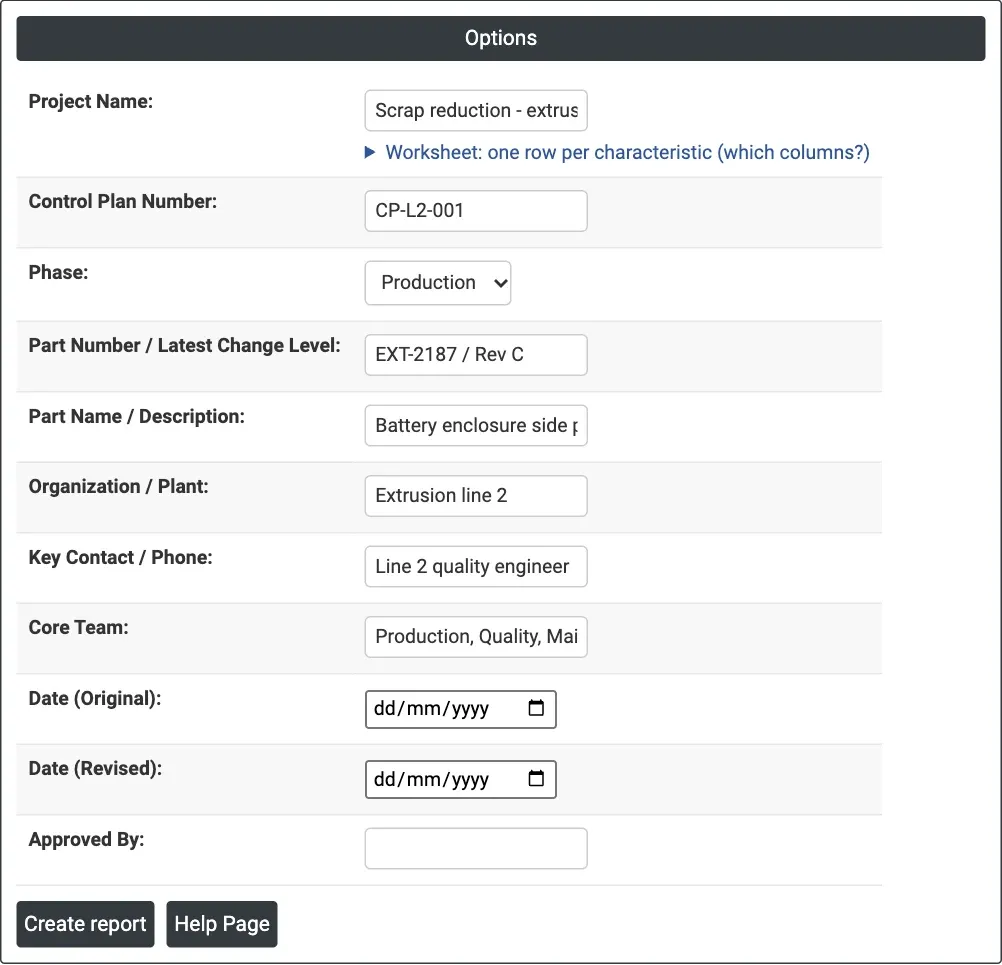
Figure 1 — The extrusion example: header fields for the control plan of extrusion line 2; the characteristics come from the worksheet.
Output Descriptions
- Control Plan header — the project, plan number, phase, part, plant, contact, team, dates and approval.
- Characteristics — one row per characteristic in the standard column order: process number, operation, machine, characteristic number, product or process characteristic, special class, specification, measurement technique, sample size, frequency, control method, reaction plan and responsibility.
- StatsAI checks for this plan — for each characteristic (◆ marks a special characteristic): the gauge study to check first, the chart to monitor with, the capability study and the capability target, each linked to its StatsAI tool.
- Review — one line for each gap found, saying what to add or which study to run.
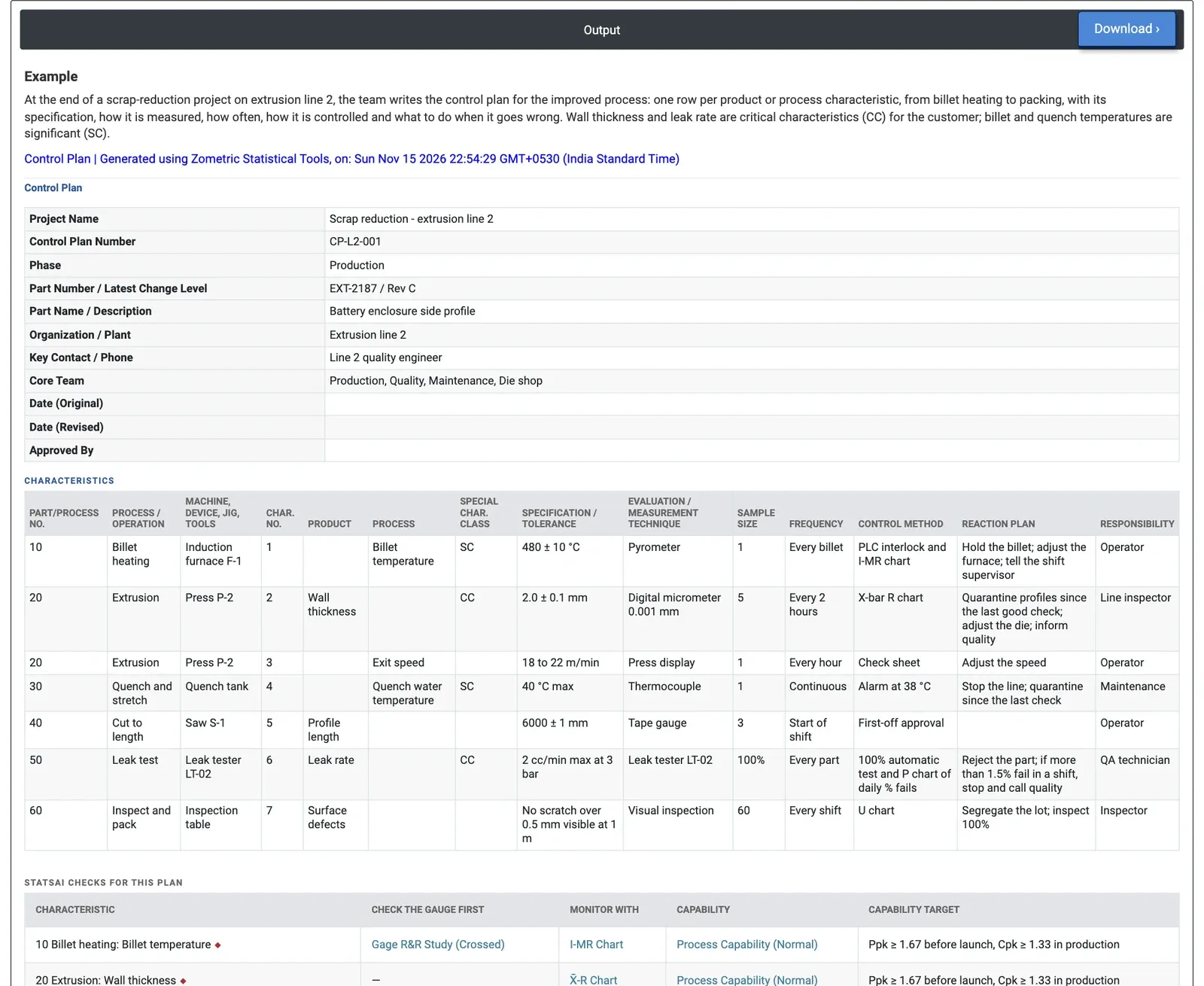
Figure 2 — Control plan output for the extrusion example: the header, the characteristics table and the start of the StatsAI checks.
Worked Example
At the end of a scrap-reduction project on extrusion line 2, the team writes the control plan for the improved process: seven characteristics from billet heating to packing. Wall thickness and leak rate are critical characteristics (CC) for the customer; billet temperature and quench water temperature are significant (SC).
The StatsAI checks give each row its next step. Billet temperature (SC, I-MR chart, MSA not done) needs a Gage R&R Study (Crossed) on the pyrometer first, then capability against Ppk ≥ 1.67 before launch and Cpk ≥ 1.33 in production. Wall thickness (CC, X-bar R chart, MSA done) goes straight to the chart and capability. Surface defects, checked visually with a U chart, need an Attribute Agreement Analysis and Poisson Capability.
The review finds six gaps: the measurement systems for billet temperature, profile length and leak rate are not validated (Gage R&R) and the visual check of surface defects is not validated (attribute agreement); quench water temperature is a special characteristic controlled only by an alarm, with no SPC or error-proofing; and profile length has no reaction plan. Fixing these rows before the plan is released closes the usual audit findings.