
Project Risk Assessment
On this page
Purpose
Project Risk Assessment scores how likely an improvement project is to run into trouble, before it is approved. The team answers 30 standard questions about the project's scope, its leadership and resources, the team leader and the way it will close and pay back, and weights each question by how much it matters for this project. The tool turns the answers into risk scores, totals them by section and overall, and shows where the risk is concentrated, so the sponsor can fix the weak points (or reshape the project) before work starts.
Key Capabilities
- Four sections of evaluation criteria: Scope / Definition of Project (15), Deployment / Leadership (6), Team Leader (Black/Green Belt) (5) and Project Closure / Benefits (4).
- A weight of 1 to 9 for each criterion, set by the team.
- Five answers per criterion: Yes, Probably, Maybe, Probably Not, No.
- Risk Score per criterion, a score per section and a Total Score.
- Objective and Conclusion recorded with the assessment.
- PDF export via Download.
Statistical Methods
Each answer has a multiplier: Yes 1, Probably 3, Maybe 4, Probably Not 5, No 10. Risk Score = Weight × multiplier, shown as * until both the weight and the answer are given. Each section score is the sum of its risk scores, and the Total Score is the sum of the four section scores; criteria left blank add nothing. Every criterion is worded so that Yes is the safe answer, so a higher score means a riskier project.
The scores are relative, not absolute: the lowest possible total is the sum of the weights (every answer Yes) and the highest is ten times that (every answer No). Compare the total with that range, and look first at the criteria with the largest risk scores, because a single No on a heavily weighted criterion scores as much as several Probably answers. This is the usual Six Sigma project-selection check: a project with a clear customer and defect, a measurable metric, a champion, a process owner, a trained leader and hard savings is the one most likely to finish on time and deliver.
Input Fields & Options
Field | Description |
Project Name / Prepared By / Prepared Date | Header of the report. |
<Section>: <criterion> (Weight 1-9) | The importance of the criterion for this project, 1 (low) to 9 (high). One field for each of the 30 criteria. |
Answer | How well the project meets the criterion: Yes, Probably, Maybe, Probably Not or No. Blank by default. |
Objective | Free text: the purpose of the assessment. |
Conclusion | Free text: the decision taken from the scores. |
Calculate | Computes the risk scores and lays out the report. |
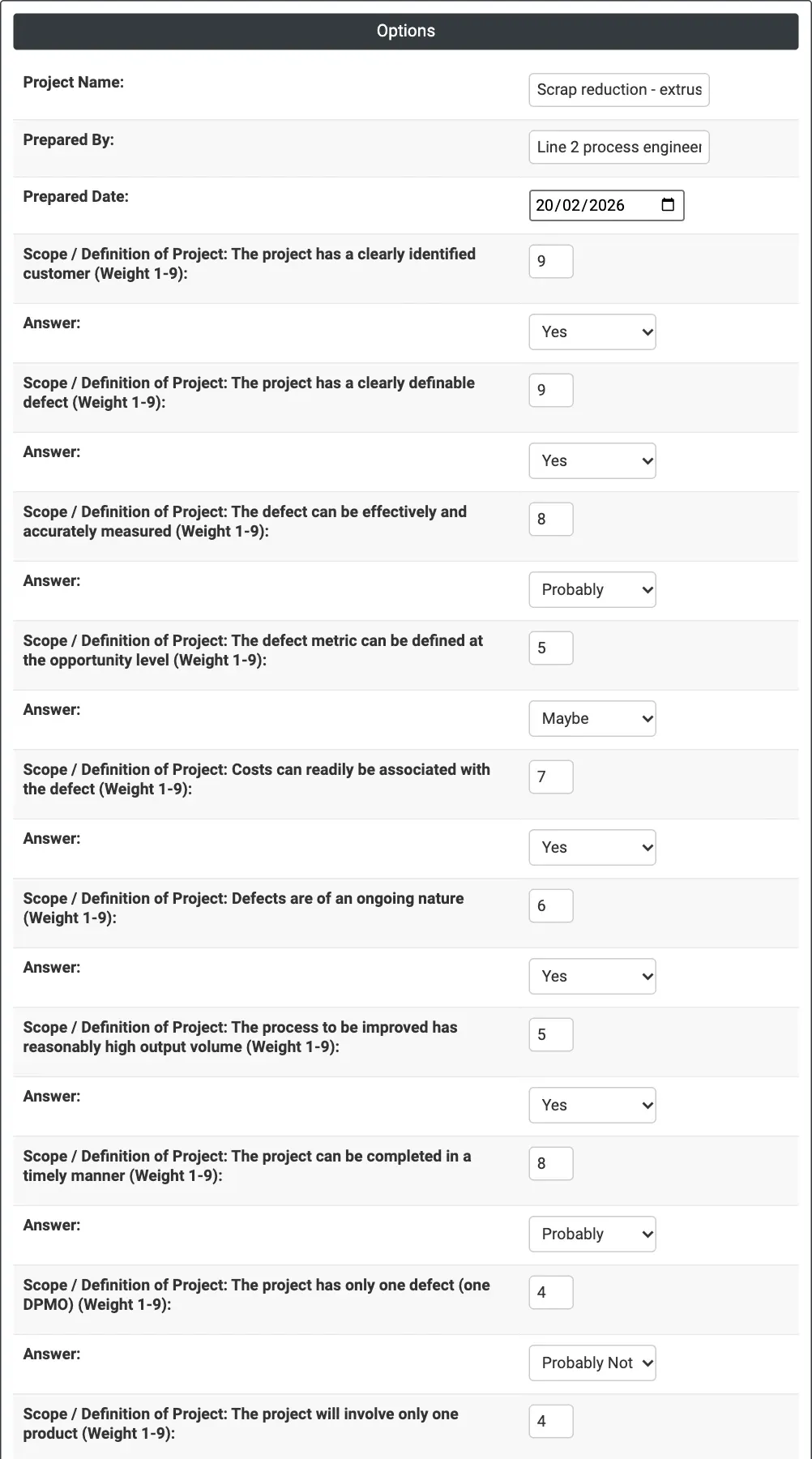
Figure 1 — The first criteria of the 30, with their weights and answers, entered for the scrap-reduction project on extrusion line 2 before charter approval.
Output Descriptions
- Project Risk Assessment — Project Name, Prepared By and Prepared Date.
- Scope / Definition of Project, Deployment / Leadership, Team Leader (Black/Green Belt) and Project Closure / Benefits — one table per section with Weight, Evaluation Criteria, Answer and Risk Score, followed by the section score.
- Total Score — the sum of the four section scores.
- Summary — the Objective and Conclusion.
- PDF export via Download.
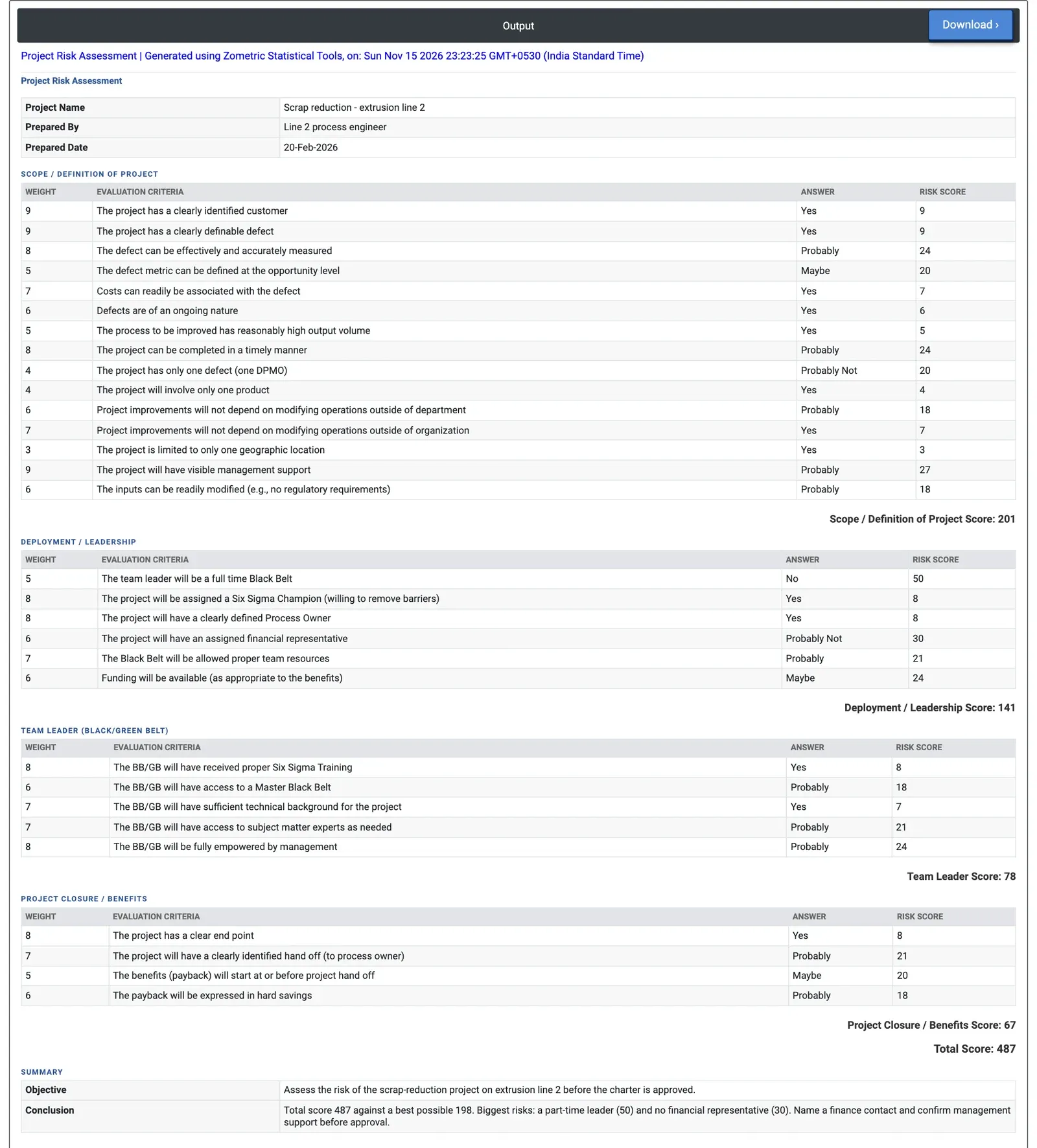
Figure 2 — Risk scores for the extrusion project: section scores 201, 141, 78 and 67, a Total Score of 487.
Worked Example
Before the scrap-reduction project on extrusion line 2 is approved, the Green Belt who will lead it scores its risk with the team (there is no Load Example for this page; the weights and answers were typed in). The project has a clear customer and defect, costs are known and the process runs at high volume, so those criteria are answered Yes. Some points are less certain: management support, whether the defect can be measured accurately and whether the project can finish on time are only Probably; the leader is not a full-time Black Belt; and no financial representative is assigned yet.
The section scores are 201 for Scope / Definition, 141 for Deployment / Leadership, 78 for Team Leader and 67 for Project Closure / Benefits, a Total Score of 487. The weights add up to 198, so the score could range from 198 (all Yes) to 1,980 (all No): this project sits near the low-risk end. The largest single scores show what to fix first: a part-time leader (weight 5, No, score 50) and no financial representative (weight 6, Probably Not, 30), then visible management support (27). Funding (Maybe, 24) and the leader's empowerment (24) also count. The team names a finance contact and asks the sponsor to confirm support and time for the leader in the charter; scoring again after those changes shows how much the risk has fallen.