
Sample Size for Tolerance Intervals
On this page
Purpose
Sample Size for Tolerance Intervals works out how many measurements are needed so that a normal tolerance interval, mean ± k·s, is narrow enough to be useful, or what k-factor a planned sample will give. A tolerance interval states, with a chosen confidence, the range that contains at least a chosen percentage of the population (for example 95% confidence that 95% of parts lie inside). Small samples give large k-factors and wide intervals, so this tool is used when planning process validation runs, for example a 95/95 study that must show the interval fits within the specification.
Key Capabilities
- Solves for the minimum sample size that reaches one or more target k-factors, or reports the k-factor achieved by planned sample sizes: leave blank the one you want.
- Several values at once, e.g. target k-factors “2.5 3” or sample sizes “10 20 50”, give one row each.
- Two-sided intervals (mean ± k·s) or one-sided bounds (mean + k·s or mean − k·s).
- Any confidence level and minimum population coverage from 75 to 100%.
- Uses the same exact k-factors as the Tolerance Interval (Normal) tool.
Statistical Methods
The interval assumes the data come from a normal distribution and are summarised by the sample mean x̄ and standard deviation s. The interval is x̄ ± k·s (two-sided) or x̄ + k·s / x̄ − k·s (one-sided), and k depends only on the sample size n, the confidence level and the minimum percentage P of the population to be covered.
For the two-sided interval, k is the exact value: the coverage probability, written as an integral over the distributions of x̄ and s, is set equal to the confidence level and solved for k numerically (a noncentral t value is used as the starting point). For a one-sided bound, k = t′ / √n, where t′ is the confidence-level quantile of the noncentral t distribution with n − 1 degrees of freedom and noncentrality z_P·√n, and z_P is the standard normal quantile of P.
When solving for sample size, the tool finds the smallest n (from 4 upwards) whose k-factor is at or below the target, and reports that n and the k-factor achieved. As n grows, k falls towards the normal quantile (1.960 for a two-sided 95% coverage interval, 1.645 for a one-sided bound) but never reaches it, so a target k at or below that value cannot be met: the tool then shows an error message giving the limit. Targets close to the limit need very large samples. Higher confidence or higher coverage give larger k-factors for the same n.
Input Fields & Options
Field | Description |
Sample sizes | Space or comma-separated, e.g. “20 30 50”. Fill in to see the k-factor each sample size achieves; leave blank to solve for sample size. |
Target k-factors | Space or comma-separated, e.g. “2 3”. The largest acceptable k-factor (interval = mean ± k·s). Fill in, with Sample sizes blank, to solve for the smallest sample size that achieves it. Each target must be greater than the limit k approaches as n grows (1.960 for a two-sided interval covering 95%, 1.645 for a one-sided bound). |
Confidence level | Default 95; 75 to 100. The confidence that the interval covers at least the stated percentage of the population. |
Minimum percentage of population in interval | Default 95; 75 to 100. The coverage P. |
Tolerance Interval | Two-sided (default) or One-sided. |
Title | Title shown on the output. |
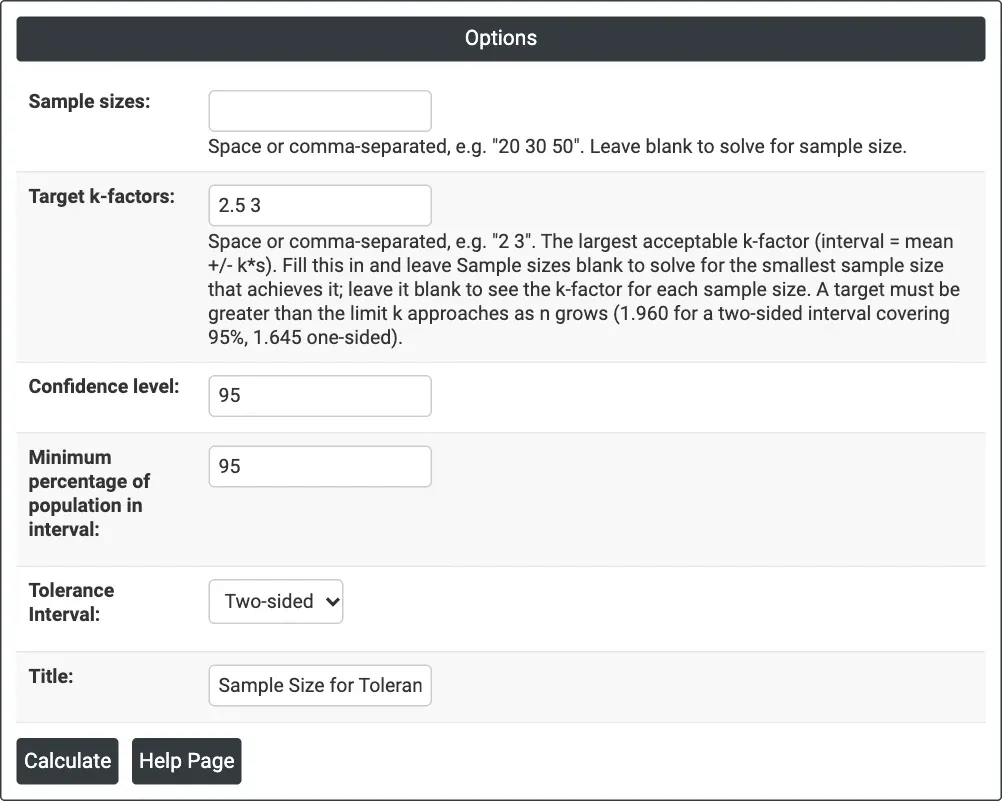
Figure 1 — Solving for sample size: Target k-factors = 2.5 3, 95% confidence, 95% of the population, two-sided interval.
Output Descriptions
- Settings — what was solved for, the confidence level, the percentage of the population in the interval and the type of tolerance interval.
- Results — when solving for sample size: target k-factor, sample size and achieved k-factor; when sample sizes are given: sample size and k-factor.
- PDF export via Download.
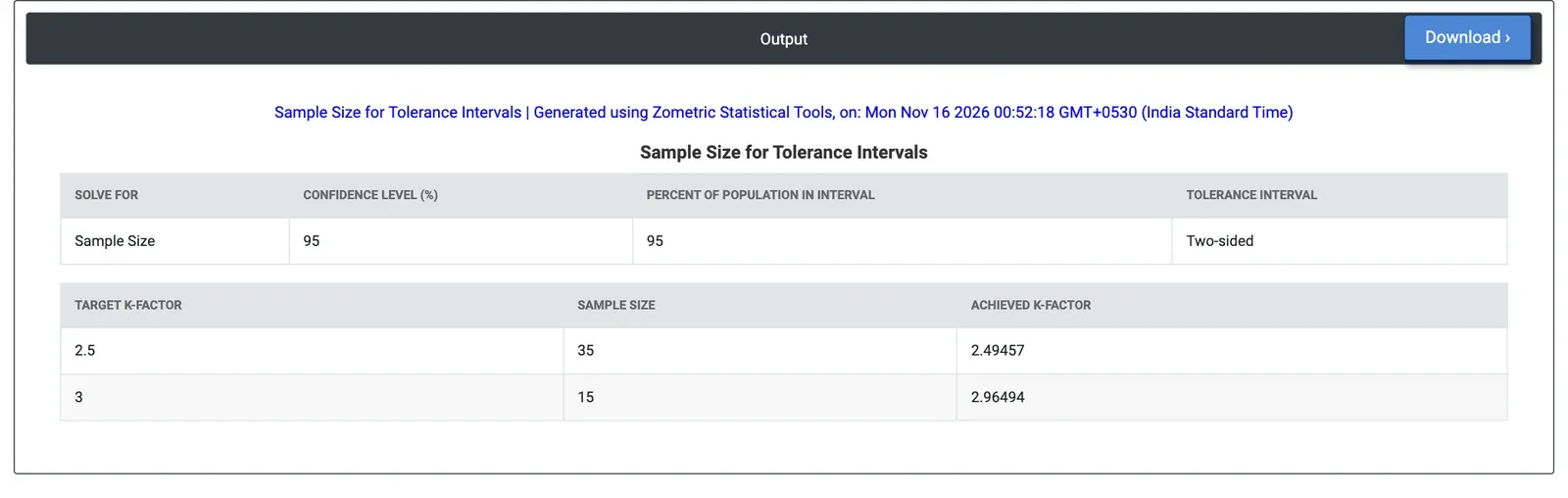
Figure 2 — Results for the example: 35 seals to reach k = 2.5 and 15 seals to reach k = 3 for a two-sided 95/95 interval.
Worked Example
A medical packaging plant is validating a heat-sealing process and must show, with 95% confidence, that 95% of seals have a peel strength within the specification. From development runs the process mean sits about 3 standard deviations from the nearer specification limit, so a tolerance interval with k up to 3 would pass, and k up to 2.5 would leave a margin. The validation engineer leaves Sample sizes blank, enters Target k-factors = 2.5 3, and keeps 95% confidence, 95% coverage and a two-sided interval.
The tool needs 15 seals to reach k = 3 (achieved k-factor 2.965) and 35 seals to reach k = 2.5 (achieved 2.495). Entering Sample sizes = 10 20 50 100 instead shows how slowly k falls: 3.393, 2.760, 2.382 and 2.234. If only a lower strength limit applies, a one-sided bound needs 10 seals for k = 3 and 17 for k = 2.5. Raising the coverage to 99% of seals makes the study much larger: k = 3 then needs 77 seals.