
SIPOC
On this page
Purpose
A SIPOC (Suppliers, Inputs, Process, Outputs, Customers) is a one-page, high-level map of the process a project will improve. It shows where the process starts and ends, the 4 to 7 main steps in between, what goes in and who supplies it, what comes out and who receives it, and the requirements on each input and output. Use it in the Define phase to agree the project scope with the sponsor and team before detailed process mapping or data collection.
Key Capabilities
- SIPOC table from worksheet columns, with Inputs and Outputs each split into Description and Requirements.
- Columns found automatically by their headings (Suppliers, Inputs, Process steps, Outputs, Customers and the two requirements columns), or chosen in the Options panel.
- Optional SIPOC diagram: five coloured column heads, the process steps drawn as a numbered chain, and the start and end events of the process.
- Optional Review notes: checks the number of process steps, empty columns and missing requirements.
- PDF export via Download.
Statistical Methods
The tool does no calculation: it arranges the worksheet into the SIPOC layout. Each column's non-blank cells are listed in worksheet order. A requirement is paired with the input or output on the same worksheet row, so keep each requirement on its item's row. When a column field is left at --, the tool uses the worksheet column whose heading matches the role, ignoring case: Supplier(s), Input(s), Input requirements (or Input specs), Process, Process steps or Steps, Output(s), Output requirements (or Output specs) and Customer(s). At least one SIPOC column must be found.
With Review notes ticked, the SIPOC is checked against the usual practice: a SIPOC shows 4 to 7 high-level steps (more suggests detailed steps should be combined, fewer that a step may be missing); Suppliers, Inputs, Outputs and Customers should not be empty; and inputs and outputs should carry requirements, because the output requirements are the customer's CTQs and the input requirements are what the process needs from its suppliers. When nothing is flagged the review says No issues found. A common way to build a SIPOC is to agree the start and end points first, then the process steps, then outputs and customers, and last inputs and suppliers.
Input Fields & Options
Field | Description |
Project Name / Prepared By / Prepared Date | Header of the report; the project name also titles the diagram. |
SIPOC diagram | Unticked by default. Ticked: also draws the SIPOC as a diagram, with the process steps as a chain. |
Process starts with / Process ends with | Shown when SIPOC diagram is ticked: the first and last events of the process, e.g. “Billet received” and “Profiles dispatched”. |
Review notes | Unticked by default. Ticked: checks for 4 to 7 process steps, empty columns and missing requirements. |
Suppliers / Inputs / Process steps / Outputs / Customers | The worksheet column for each role. Blank (--) = the worksheet column named like this heading, if there is one. |
Input requirements (optional) / Output requirements (optional) | The requirement of each input or output, on the same row as its item; output requirements are what the customer needs (CTQs). |
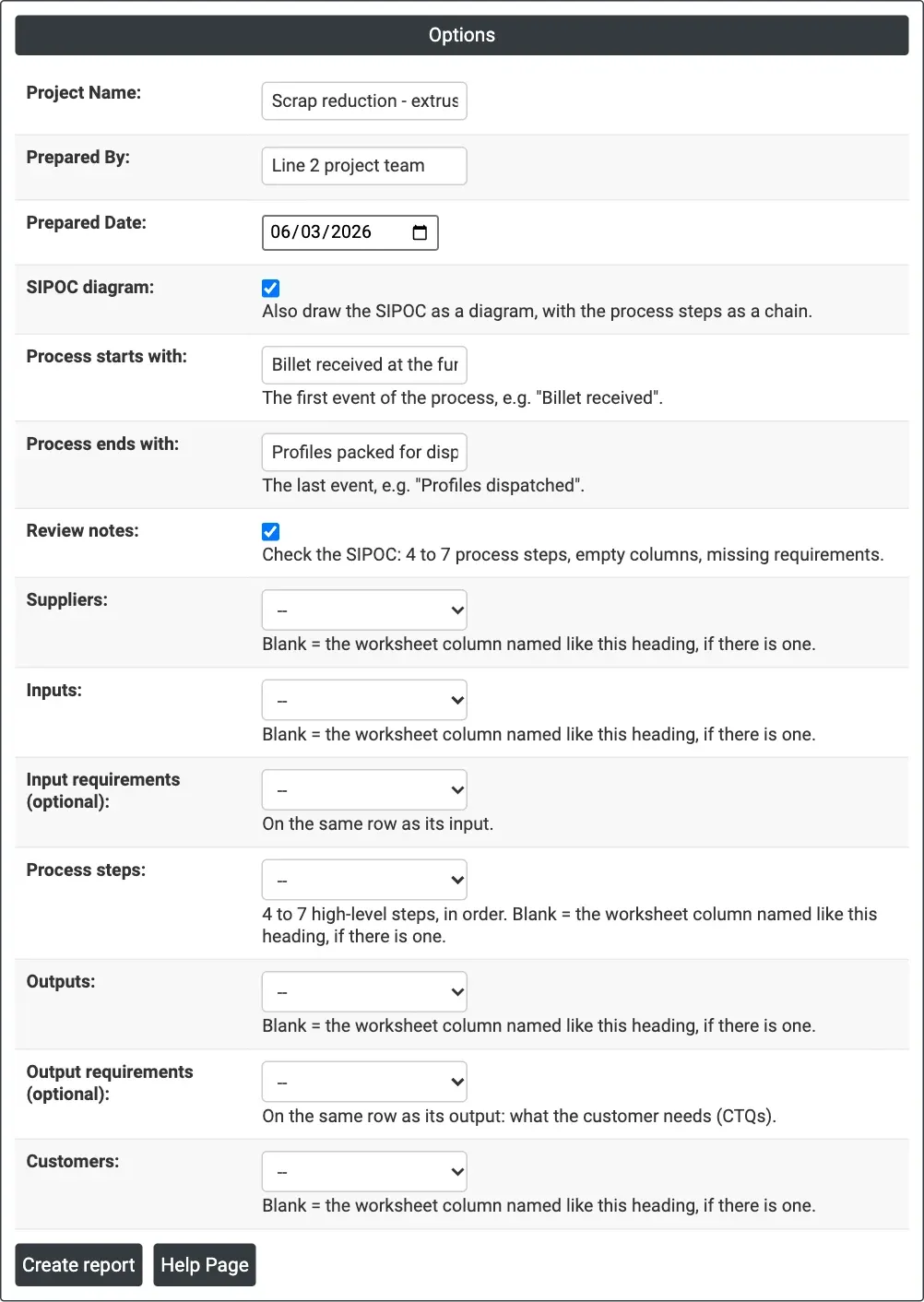
Figure 1 — Options for the example: SIPOC diagram and Review notes ticked, with the process starting when the billet is received at the furnace and ending when profiles are packed for dispatch; the columns are found by their headings.
Output Descriptions
- SIPOC — Project Name, Prepared By and Prepared Date, then the SIPOC table: Suppliers, Inputs (Description, Requirements), Process, Outputs (Description, Requirements) and Customers.
- SIPOC diagram — titled SIPOC: <project name>; the five columns with the process steps numbered in a chain between the start and end events (when SIPOC diagram is ticked).
- Review Notes — the review's findings (when Review notes is ticked).
- PDF export via Download.
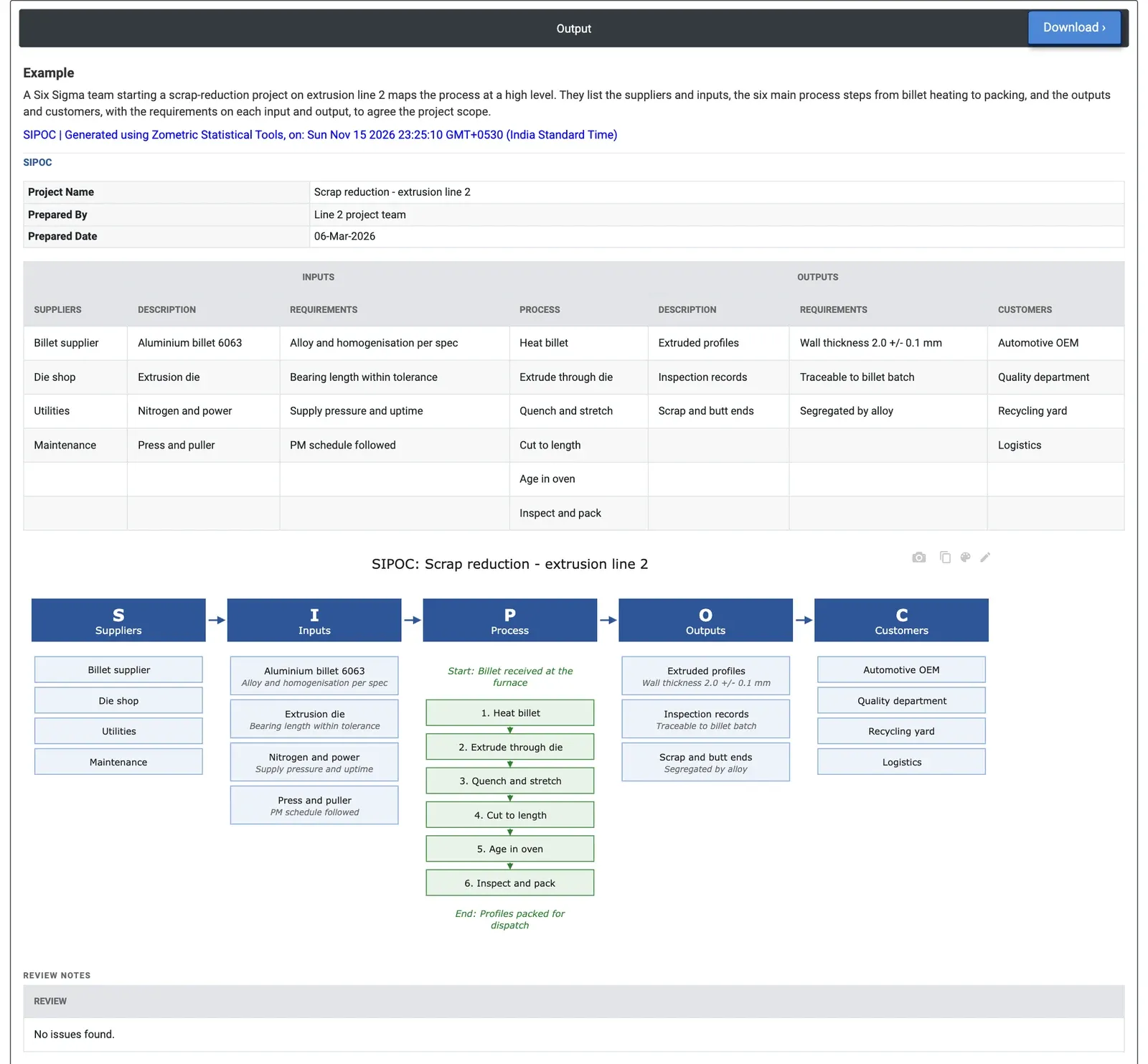
Figure 2 — SIPOC of extrusion line 2: four suppliers and inputs, six process steps from Heat billet to Inspect and pack, three outputs and four customers.
Worked Example
A Six Sigma team starting a scrap-reduction project on extrusion line 2 maps the process at a high level to agree the project scope. The worksheet has the columns Suppliers, Inputs, Input requirements, Process steps, Outputs, Output requirements and Customers, so all the column fields are left blank and found by their headings. The team ticks SIPOC diagram and Review notes and sets the boundaries: the process starts when the billet is received at the furnace and ends when the profiles are packed for dispatch.
The SIPOC shows four suppliers and their inputs, each with a requirement: the billet supplier provides 6063 aluminium billet (alloy and homogenisation per specification), the die shop the extrusion die (bearing length within tolerance), utilities nitrogen and power (supply pressure and uptime) and maintenance the press and puller (PM schedule followed). Six steps run from Heat billet to Inspect and pack. Three outputs go to four customers: extruded profiles with wall thickness 2.0 ± 0.1 mm for the automotive OEM, inspection records traceable to the billet batch for the quality department, and scrap and butt ends segregated by alloy for the recycling yard, with logistics also listed as a customer. Six steps fall within the 4 to 7 range and every input and output has a requirement, so the review finds no issues. The SIPOC now fixes the scope for the charter, and the wall thickness requirement is the obvious candidate for the main project Y.