
Variables Acceptance Sampling: Accept/Reject Lot
On this page
Purpose
Variables Acceptance Sampling: Accept/Reject Lot applies an existing variables sampling plan to a real sample. You measure the sample taken from an incoming or outgoing lot, enter the specification limits and the plan's critical distance k, and the tool tells you whether to accept or reject the lot, and why. It is the step after designing the plan (for example with Create a Sampling Plan, which gives the sample size n and k): use it at receiving or final inspection when the characteristic is measured, not just judged pass or fail.
Key Capabilities
- Accept or reject decision with the reasons: which criterion failed, or that all were met.
- Works with a lower limit, an upper limit or both.
- Uses the sample's own standard deviation, or a known historical standard deviation when you have one.
- With both limits and no historical standard deviation, also checks the sample standard deviation against the Maximum Standard Deviation (MSD).
- Summary table (sample size, mean, standard deviations, k) and the Z values compared with k.
- PDF export via Download.
Statistical Methods
From the n measurements the tool computes the sample mean x̄ and the sample standard deviation s (n − 1 divisor). The standard deviation used, σ, is the historical standard deviation if one is entered, otherwise s. The distances from the mean to the limits in standard deviations are Z.LSL = (x̄ − LSL) / σ and Z.USL = (USL − x̄) / σ. The lot is accepted when every Z that applies is at least the critical distance k: with only an LSL, Z.LSL ≥ k; with only a USL, Z.USL ≥ k; with both, both must be at least k.
When both limits are given and σ is not known, the sample standard deviation must also be no larger than the Maximum Standard Deviation, from the Wallis approximation used for the two-sided, σ-unknown case of ANSI/ASQ Z1.9 and MIL-STD-414: p* = 1 − Φ(k), Zp* = Φ⁻¹(1 − p*/2) and MSD = (USL − LSL) / (2·Zp*). A sample that is too spread out fails even when its mean is well centred. The plan assumes the characteristic is roughly normally distributed and the sample is taken at random from the lot; k must come from the same plan (sample size and AQL) as the sample. At least 2 measurements are needed.
Input Fields & Options
Field | Description |
Measurement column | Required. The column of raw measurements taken from the sampled lot. |
Lower spec (LSL) / Upper spec (USL) | At least one is required; USL cannot be less than LSL. |
Critical distance (k) | Required. The acceptability constant k from an already-designed sampling plan, e.g. the “Critical distance (K value)” reported by Create a Sampling Plan. |
Historical standard deviation | Optional. If known, used in place of the sample's own standard deviation. With both limits and this left blank, the sample standard deviation is also checked against the Maximum Standard Deviation (Wallis approximation). |
Title | Default Variables Acceptance Sampling: Accept/Reject Lot; shown as the heading of the output. |
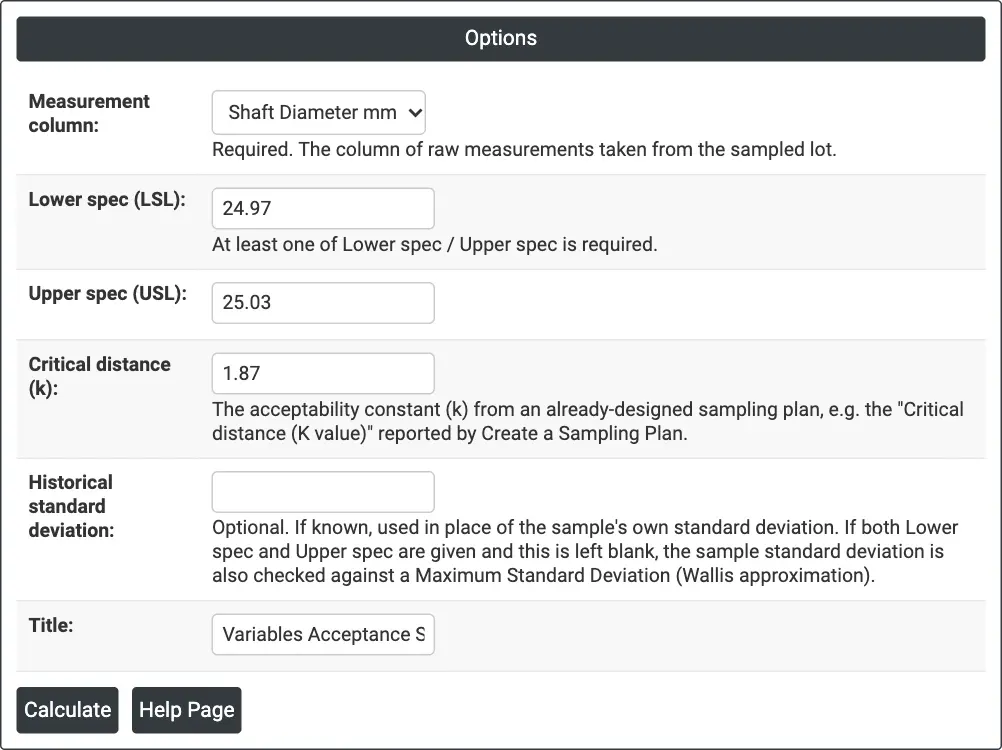
Figure 1 — Options for the example: shaft diameters, specification 24.97 to 25.03 mm, critical distance k = 1.87, no historical standard deviation.
Output Descriptions
- Title — the Title field, as the heading of the output.
- Decision — Accept the lot (green) or Reject the lot (red), with the reasons.
- Summary — Sample size (n), Sample mean, Sample standard deviation, Standard deviation used and Critical distance (k).
- Evaluation — Z.LSL and/or Z.USL, and the Maximum Standard Deviation (MSD) when it applies.
- PDF export via Download.
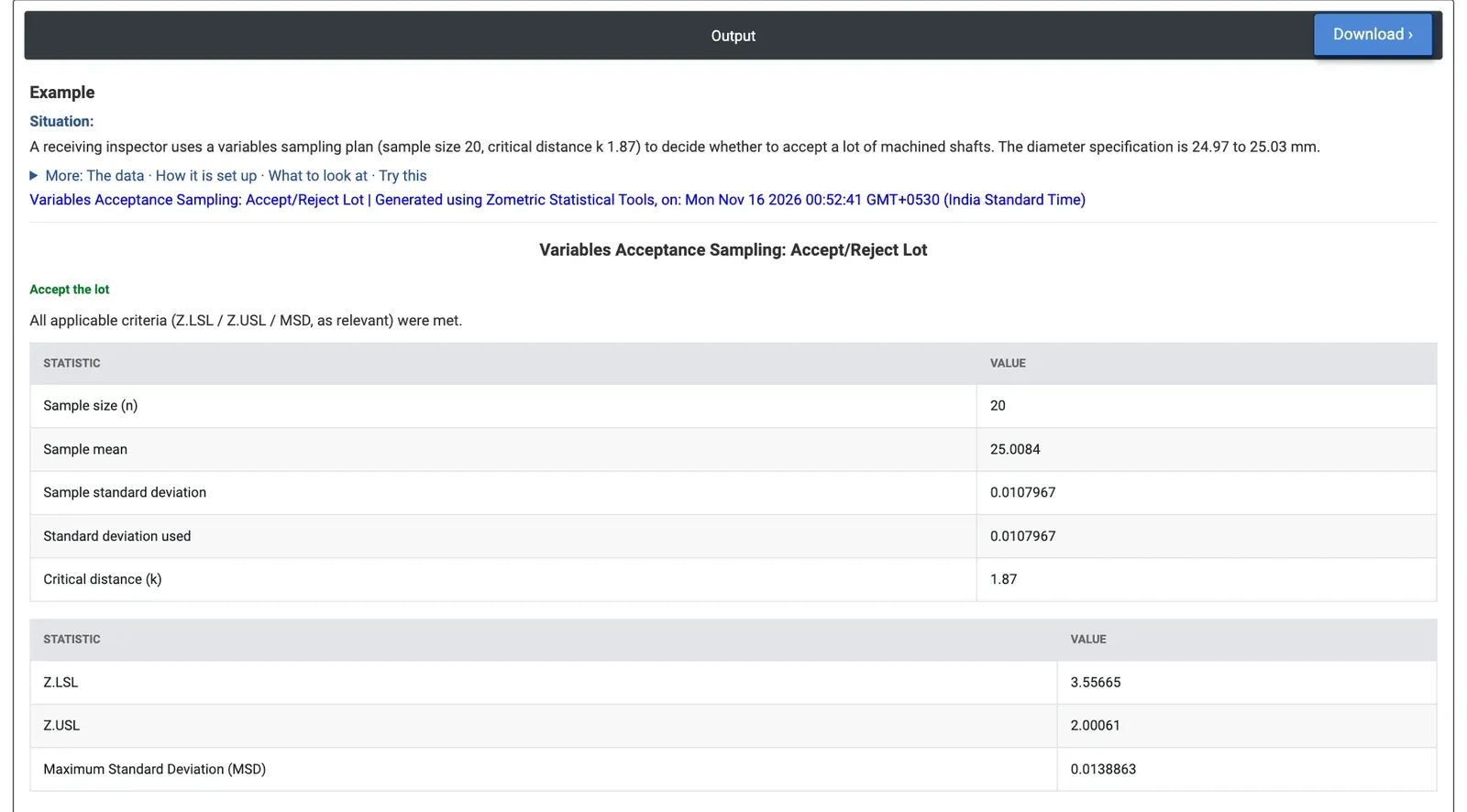
Figure 2 — The shaft lot is accepted: Z.LSL 3.56 and Z.USL 2.00 are both at least k = 1.87, and s = 0.0108 is below the MSD of 0.0139.
Worked Example
A receiving inspector checks a lot of machined shafts against a variables sampling plan with sample size 20 and critical distance k = 1.87. The diameter specification is 24.97 to 25.03 mm. Twenty shafts are taken at random from the lot and measured, the column Shaft Diameter mm is chosen, and Historical standard deviation is left blank because the supplier's process spread is not known.
The sample mean is 25.0084 mm and the sample standard deviation 0.0108 mm. Z.LSL = (25.0084 − 24.97) / 0.0108 = 3.56 and Z.USL = (25.03 − 25.0084) / 0.0108 = 2.00, both at least 1.87, and the standard deviation is below the MSD of 0.0139 mm, so the lot is accepted. The mean sits off-centre towards the USL and Z.USL is the closer call: a sample mean above about 25.0098 mm, with the same spread, would have failed. If the supplier's long-term standard deviation were known to be 0.015 mm and entered as the historical standard deviation, Z.USL would drop to 1.44 and the lot would be rejected, so the inspector should feed back to the supplier that the diameters are running high even though this lot passes.