
Project Charter
The Project Charter lays out a DMAIC-style charter: header, dates and duration, classification, problem statement, objective, business case, scope, assessment and approval. An Improvement Metrics table shows baseline, target, actual and percent change from the worksheet. Optional review notes flag unmeasurable problem statements or objectives, missing scope or sponsor, inconsistent dates and metrics without targets. Use it in Define and update it at each phase gate.
Last reviewed
Key takeaway
A project charter is the one-page agreement that starts an improvement project, stating the problem, the objective and deadline, scope, business case, leader and sponsor, and how success is measured.
On this page
Purpose
The Project Charter is the one-page agreement that starts an improvement project: what the problem is, what the project must achieve and by when, its scope and business case, who leads and sponsors it, and how its success is measured. The tool lays the charter out in the sections of a standard DMAIC charter form, adds an Improvement Metrics table (baseline, target, actual and percent change) from the worksheet, and can review the charter for the usual weaknesses. Use it in the Define phase, and update it at each phase gate and at project close.
Key Capabilities
- Charter sections: project header, Progress & Dates, Project Classification, Project Definition, Project Assessment, Improvement Metrics and Project Approval.
- Duration (days) worked out from the start and completion dates.
- Improvement Metrics from worksheet columns Metric, Baseline, Target and Actual, with the percent change of each metric.
- Review notes: checks that the problem statement and objective are measurable, that scope and sponsor are given, that dates are consistent and that every metric has a target.
- Methodology choices beyond DMAIC (8D, PDCA, Kaizen Event, CDOV and others), so one charter format serves every project type.
- PDF export via Download.
Statistical Methods
The charter is a project document, and the tool applies a few simple rules. Duration (days) = Completion Date − Start Date, shown as * until both are set. For each metric, Percent Change = (Actual − Baseline) / Baseline × 100, shown as * when Actual or Baseline is missing or the baseline is 0. Metric columns are matched by heading, ignoring case: Metric (also Measure or KPI), Baseline (also Current or Before), Target (also Goal) and Actual (also Achieved, After or Result). Dates are shown as day-month-year.
With Review notes ticked, the charter is checked against standard Six Sigma practice. The problem statement should state the size of the problem with a number and should not suggest a cause or a solution (words such as implement, install, replace, lack of or need to are flagged). The objective should be measurable (contain a number) and have a deadline (a date, month, quarter or a phrase such as within 6 weeks). The charter needs a project name, a scope and a sponsor; the Due Date must not be before the Start Date; a Completed project needs a Completion Date; and every improvement metric needs a target. When nothing is flagged the review says No issues found.
Input Fields & Options
Field | Description |
Project Name / Project Leader / Sponsor / Project Number | Charter header. |
Status | Not Started (default), In Progress, Completed, On Hold or Cancelled. |
Start Date / Due Date / Completion Date | Project dates; Duration (days) is computed from Start and Completion. |
Business Unit / Department / Location | Where the project sits in the organisation. |
Methodology | 8D, Basic Project, DMAIC (default), CDOV, PDCA, Kaizen Event, Just Do It, QFD or Other. |
Belt Level | Green Belt, Black Belt, Master Black Belt or Other. |
Problem Statement / Objective / Business Case | Free text: what is wrong and how big, what the project will achieve by when, and why it matters to the business. |
Benefit Type | Cost Avoidance, Cost Reduction, External Customer Satisfaction, Margin Growth or Other. |
Product/Service / Process / Value Stream / Critical To | What the project covers and what it is critical to (for example quality, cost or delivery). |
Scope / Results & Benefits / Keywords | Where the process starts and ends and what is excluded; the results achieved; search keywords. |
Health / Risk / Complexity | Health: Green, Yellow or Red. Risk and Complexity: High, Medium or Low. |
Replication Opportunity? / Best Practice Project? | Yes or No. |
Approved By / Approved Date | Charter approval. |
Review notes | Unticked by default. Ticked: checks the charter and lists what to fix. Improvement Metrics come from worksheet columns Metric, Baseline, Target and Actual. |
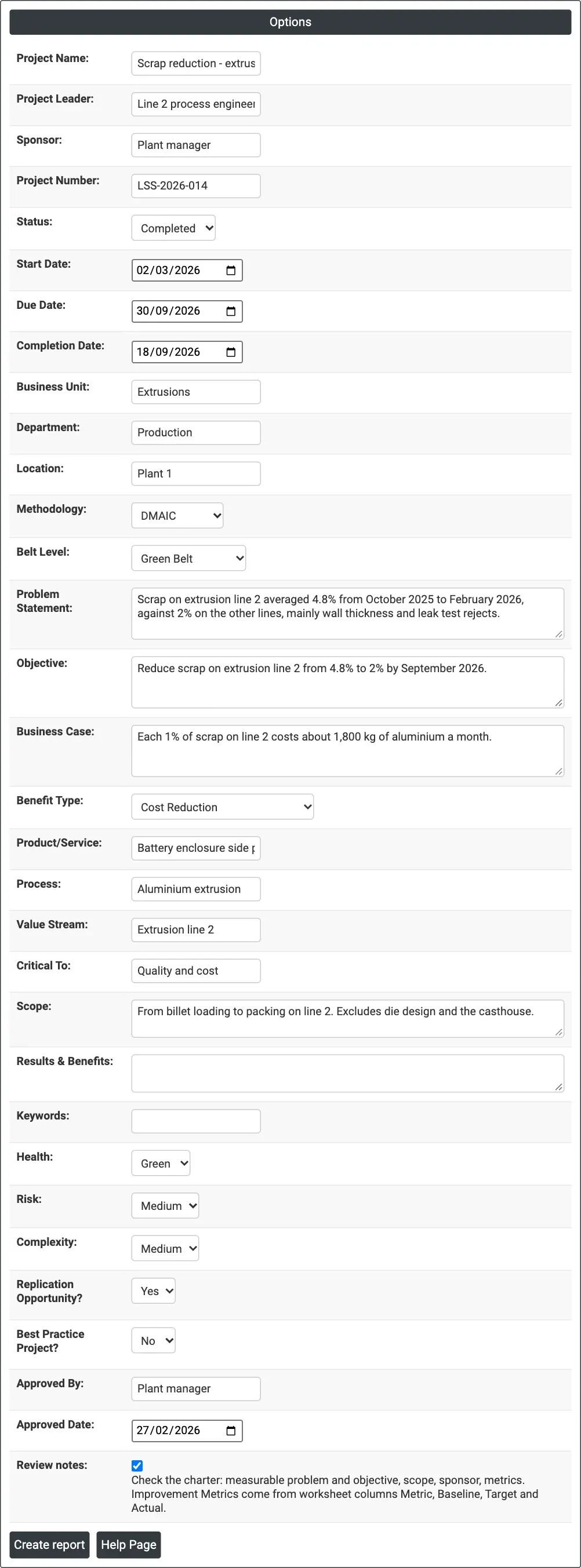
Figure 1 — The charter of the scrap-reduction project on extrusion line 2, with Review notes ticked.
Output Descriptions
- Project Charter — the header, then the sections Progress & Dates (with Duration (days)), Project Classification, Project Definition and Project Assessment.
- Improvement Metrics — Metric, Baseline, Target, Actual and Percent Change, from the worksheet.
- Project Approval — Approved By and Approved Date.
- Review Notes — the review's findings, when Review notes is ticked.
- PDF export via Download.
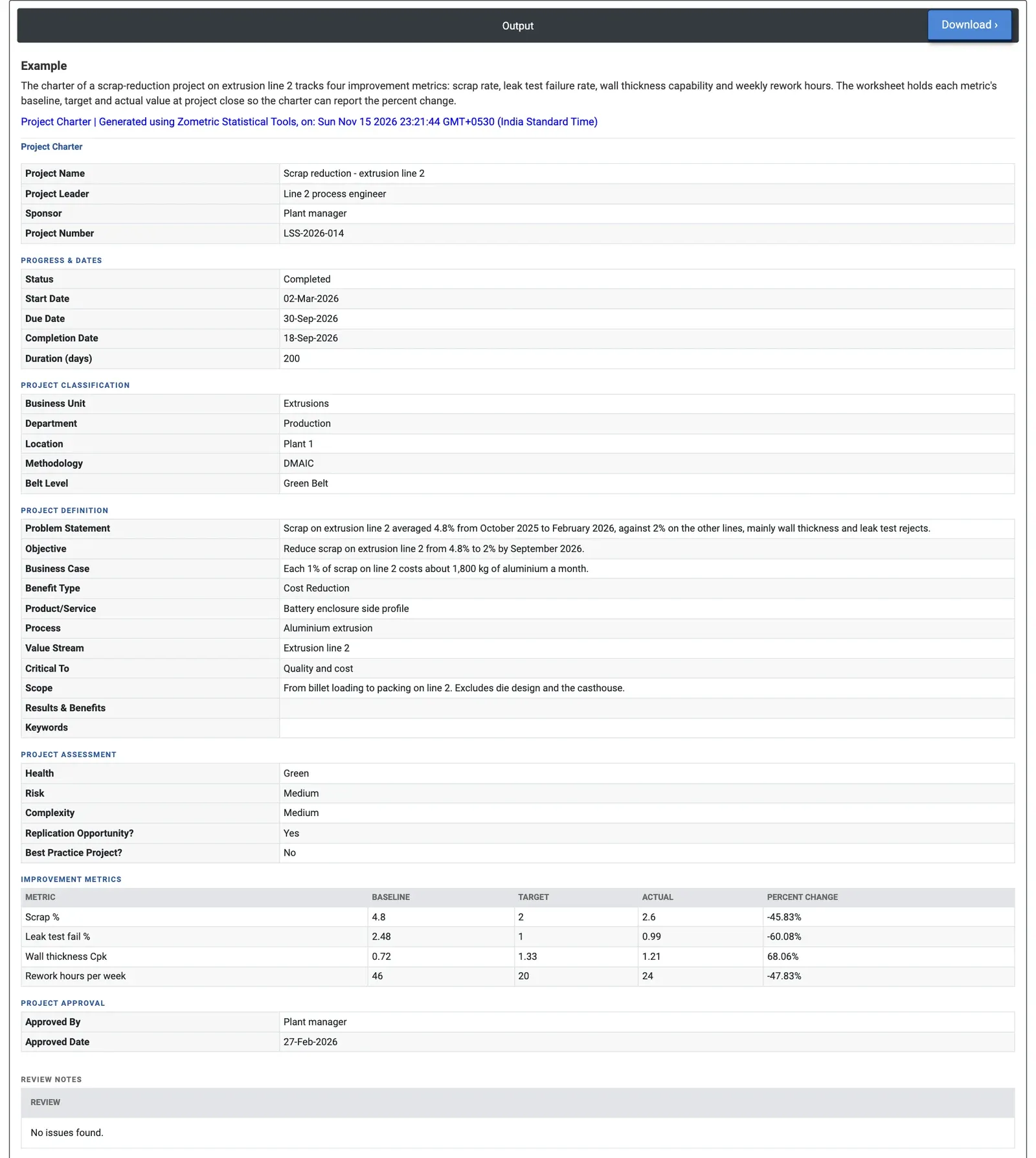
Figure 2 — The completed charter: 200 days from start to completion, four improvement metrics with their percent change, and no review issues.
Worked Example
A Green Belt project reduced scrap on extrusion line 2. Load Example fills the project name, process, value stream and the worksheet of four improvement metrics; the remaining fields were typed in for this example. The problem statement gives the size of the problem (scrap averaged 4.8% from October 2025 to February 2026, against 2% on the other lines), the objective is to reduce scrap from 4.8% to 2% by September 2026, and the scope runs from billet loading to packing, excluding die design and the casthouse. The project started on 02-Mar-2026, was due on 30-Sep-2026 and was completed on 18-Sep-2026: a duration of 200 days.
The Improvement Metrics show what the project delivered. Scrap fell from 4.8% to 2.6% (−45.83%), short of the 2% target. The leak test fail rate fell from 2.48% to 0.99% (−60.08%), meeting its 1% target. Wall thickness Cpk rose from 0.72 to 1.21 (+68.06%) but has not reached 1.33, and rework fell from 46 to 24 hours a week (−47.83%) against a target of 20. With Review notes ticked the review finds no issues. For the close-out the sponsor sees a large gain that did not fully reach the targets; the Control phase must hold it while the remaining gap in scrap and wall thickness capability is handed to a follow-up project.
Frequently asked questions
What should a Six Sigma project charter include?
A project charter states what the problem is, what the project must achieve and by when, its scope and business case, who leads and sponsors it, and how success is measured. Sections include the project header, progress and dates, project classification, project definition, project assessment, improvement metrics with baseline, target and actual values, and project approval.
How do you write a good problem statement for a project charter?
The problem statement should state the size of the problem with a number and should not suggest a cause or a solution; words such as implement, install, replace, lack of or need to are flagged by the review. For example, scrap averaged 4.8% from October 2025 to February 2026, against 2% on the other lines.
What makes a project charter objective measurable?
The objective should contain a number and a deadline, such as a date, month, quarter or a phrase like within 6 weeks. For example: reduce scrap from 4.8% to 2% by September 2026. Every improvement metric should also have a target so that percent change against the baseline can be judged.
When should a project charter be updated?
Use the charter in the Define phase to start the project, then update it at each phase gate and at project close. At close-out, the Improvement Metrics table shows baseline, target, actual and percent change for each metric, so the sponsor can see which targets were met and which gaps should be handed to a follow-up project.