
Bioassay - Quantal Response Method
The Quantal Response Method analyses the number of subjects responding out of those tested in each dose group, fitting a logit, probit, gompit or log-log model on log(dose) with a common slope across preparations. It estimates effective doses such as ED50 and relative potency, with chi-square validity tests for regression, parallelism and linearity. A Spearman-Karber ED50 cross-check is optional.
Last reviewed
Key takeaway
The quantal response method estimates effective doses such as ED50 and the relative potency of a test preparation from bioassays with binary outcomes, such as survived or died, using a GLM on log(dose).
On this page
What is Bioassay — Quantal Response Method?
The Quantal Response Method is a statistical procedure used to estimate relative potency and effective dose (ED) values from bioassays where the measured outcome is binary (quantal) — for example, whether an animal survived or died, or whether a subject responded or did not respond — rather than a continuous measurement.
In a quantal response assay, each dose group reports the number of subjects responding out of the total number of subjects tested. A generalized linear model (using a logit, probit, gompit, or log-log link function) is fit on the log(dose) scale, with a common slope shared across the standard and test preparation(s), giving both an effective dose (such as ED50, the dose expected to produce a response in 50% of subjects) and a relative potency estimate.
Validity is confirmed via likelihood-ratio chi-square tests for the significance of the dose-response relationship, parallelism between preparations, and linearity of the fitted model — the quantal-response equivalent of the validity checks used in the Parallel Line Method.
The Quantal Response Method is used in toxicology, vaccine, and other biological potency testing — for example, LD50/ED50 determination — in line with USP <111> and European Pharmacopoeia 5.3.
When to use Bioassay — Quantal Response Method?
Use the Quantal Response Method when the measured response for each subject is binary (responded/did not respond) rather than a continuous measurement, and you need to estimate an effective dose (e.g. ED50) or compare potency between a standard and one or more test preparations.
Guidelines for correct usage of Bioassay — Quantal Response Method
- Ensure 0 <= Response <= Subject for every row (Response cannot exceed the total number of subjects tested)
- Use at least 3-4 dose levels per preparation so the dose-response curve and its validity can be properly assessed
- Choose the link function that best matches the biological response mechanism — logit and probit are the most common defaults
- Ensure the dose range tested spans a reasonable portion of the response curve (ideally from near 0% to near 100% response) for reliable ED50 estimation
- Enable the Spearman-Karber option as a distribution-free cross-check on the ED50 estimate, particularly useful if you are unsure the chosen link function is a good fit
- Always check the validity tests before reporting an ED value or potency result
Alternatives: When not to use Bioassay — Quantal Response Method
If the measured response is a continuous measurement rather than binary, use the Parallel Line Method, Slope Ratio Method, or Four-Parameter Logistic Method instead, depending on whether the response is linear in log(dose), linear in dose, or sigmoidal.
Example of Bioassay — Quantal Response Method?
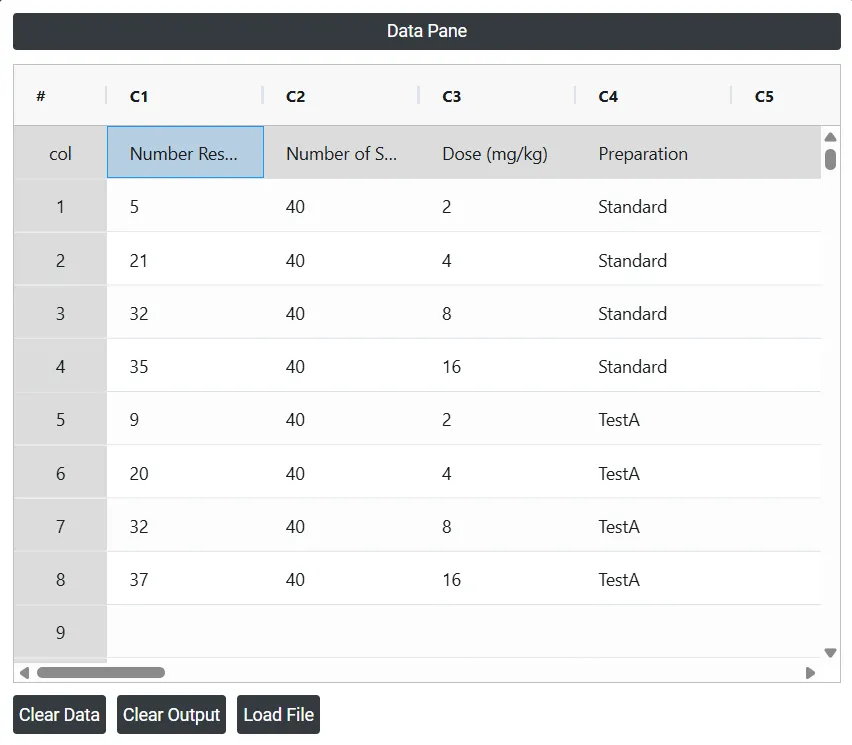
A toxicology researcher measures mortality in groups of 40 test subjects, dosed at 4 concentration levels, for a Standard and a Test preparation, and wants to compare relative potency (LD50 ratio). The researcher follows these steps:
- Gathered the necessary data.
- Now analyse the data in Zometric Statistical Software at https://statsai.zometric.com/.
- To find Bioassay — Quantal Response Method, choose Statistical module > Regression > Bioassay — Quantal Response Method.
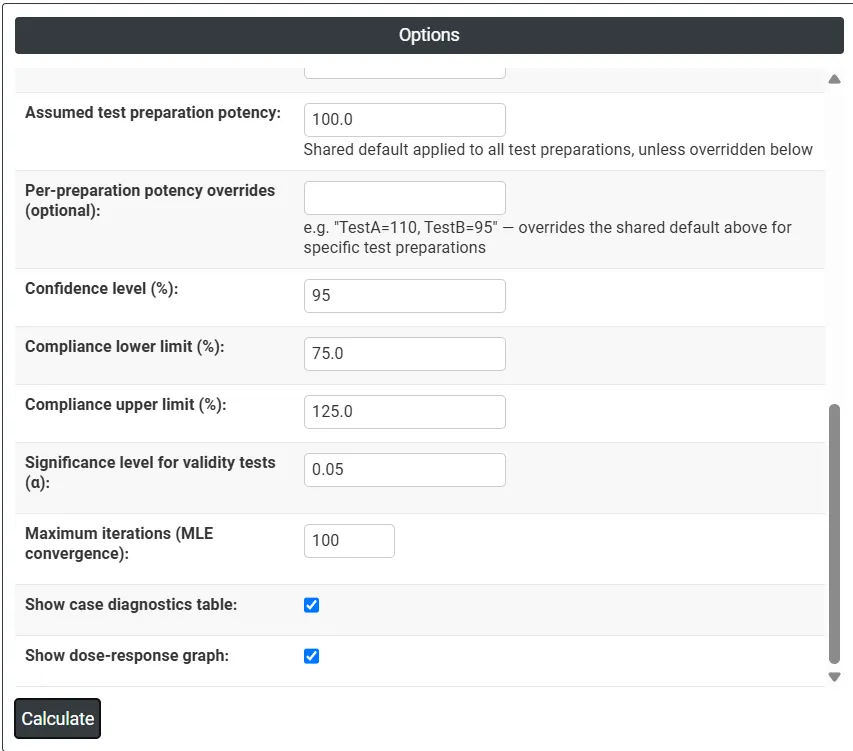
- Inside the tool, feeds the data along with other inputs as follows:
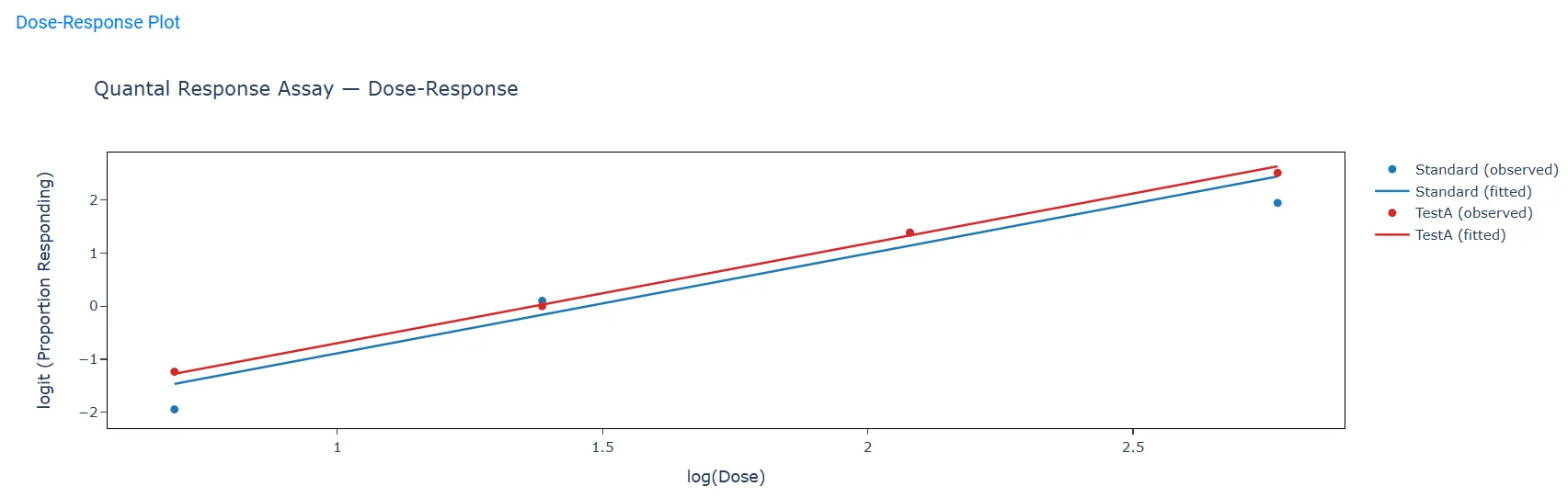
- After using the above mentioned tool, fetches the output as follows:
How to generate Bioassay — Quantal Response Method?
The guide is as follows:
- Log in to Zometric Statistical Software at https://statsai.zometric.com/.
- On the home page, choose Statistical Tool > Regression > Bioassay — Quantal Response Method.
- Click on Bioassay — Quantal Response Method and will reach the dashboard.
- Next, update the data manually or can completely copy (Ctrl+C) the data from excel sheet and paste (Ctrl+V) it here.
- Next, you need to select the Response, Subject, Dose, and Preparation columns, enter the Standard preparation label, and choose the link function and effective dose percentiles.
- Finally, click on calculate at the bottom of the page and you will get desired results.
On the dashboard of Bioassay — Quantal Response Method, the window is separated into two parts.
On the left part, Data Pane is present. Data can be fed manually or the one can completely copy (Ctrl+C) the data from excel sheet and paste (Ctrl+V) it here.
- Load example: Sample data will be loaded.
- Load File: It is used to directly load the excel data.
On the right part, there are many options present as follows:
- Response: The column containing the number of subjects responding positively in each group.
- Subject: The column containing the total number of subjects in each group.
- Dose: The column containing the dose administered. Values must be strictly positive.
- Preparation: The column identifying which preparation (Standard or Test) each observation belongs to.
- Standard preparation label: The exact text used in the Preparation column to identify the standard (e.g., "Standard").
- Link function: Logit, Probit, Gompit (complementary log-log), or Log-log — the transformation relating dose to response probability.
- Logarithm base: Natural log or log base 10 — the transformation applied to the Dose column.
- Effective dose percentiles: Comma-separated percentiles to compute (e.g. "10, 50, 90" for ED10/ED50/ED90).
- Also compute ED50 via Spearman-Karber method: Adds a distribution-free cross-check alongside the model-based ED50.
- Assumed standard potency / Assumed test preparation potency: The nominal (labelled) potency of the standard and test preparation(s), used to convert the relative potency into absolute estimated potency.
- Confidence level: The confidence level (%) used for the ED and potency confidence limits.
- Compliance lower limit / Compliance upper limit: The acceptable range (%) for the estimated relative potency, used to flag Pass/Fail compliance.
- Validity test method: How the Regression/Non-parallelism/Non-linearity validity tests are computed. Finney's classical method is more numerically stable when a dose group has a 0% or 100% observed response. (learn more)
- Significance level for validity tests (α): The significance threshold used for the Regression, Parallelism, and Linearity validity tests.
- Maximum iterations: The maximum number of iterations allowed for the model fit to converge.
- Show case diagnostics table / Show dose-response graph: Toggles to include or exclude these sections from the output.
- Download as Excel: This will display the result in an Excel format, which can be easily edited and reloaded for calculations using the load file option.
Frequently asked questions
What is a quantal response bioassay?
A quantal response bioassay is one where each subject's outcome is binary, such as survived or died, or responded or did not respond. Each dose group reports the number responding out of the number tested, and a generalised linear model on log(dose) with a common slope gives effective doses such as ED50 and a relative potency estimate.
What is ED50 in a quantal response assay?
ED50 is the dose expected to produce a response in 50% of subjects. The method can compute any effective dose percentiles you list, such as ED10, ED50 and ED90, with confidence limits. For reliable ED50 estimation, the tested dose range should span a reasonable part of the response curve, ideally from near 0% to near 100% response.
Which link function should you use for quantal response data?
Choose the link that best matches the biological response mechanism; logit and probit are the most common defaults, with gompit (complementary log-log) and log-log also available. If unsure the chosen link fits well, enable the Spearman-Karber option as a distribution-free cross-check on the ED50 estimate.
How do you run a quantal response bioassay in Zometric Statistical Software?
Choose Statistical Tool > Regression > Bioassay - Quantal Response Method, then select the Response (number responding), Subject (number tested), Dose and Preparation columns and enter the Standard preparation label. Choose the link function, effective dose percentiles and validity test method, then click Calculate. Use at least 3 to 4 dose levels per preparation.